By NeuralRotica
In the vast landscape of human cognition, decision-making, and worldview formation, perspectives are often likened to aerial views: altitudes that dictate how the world below is perceived. The journey starts at the 0-foot view: boots on the ground, immersed in the minutiae of daily existence. Then, ascent to the 10,000-foot view occurs, where patterns emerge and the bigger picture takes shape. Next, climb to the 30,000-foot view, a near-stratospheric vantage point where individual details dissolve into grand, interconnected systems. Elevate further to the 50,000-foot view, edging toward the boundary of space, where planetary boundaries fade into cosmic scales. Finally, soar to the 199,000-foot view, nearing suborbital heights, where the solar system and beyond unfold in profound universality. This metaphorical journey is not just poetic; it is a practical framework for understanding navigation of complexity in business, personal growth, science, and society.
This article explores these five levels in depth, drawing on cognitive psychology, systems theory, and real-world examples to illustrate how shifting views can transform approaches to problems. It examines the strengths and pitfalls of each perspective, and discusses strategies for fluidly moving between them. Whether charting corporate strategy as a CEO, seeking inspiration as an artist, or simply trying to make sense of a chaotic world, mastering these altitude adjustments can be a game-changer.
The 0-Foot View – Immersion in the Trenches
At ground level, the 0-foot view, immersion in the thick of it occurs. This is the perspective of the tactile, the immediate, the sensory overload. Imagine standing in a bustling city street – horns blaring, pedestrians jostling, the scent of street food mingling with exhaust fumes. Here, every detail matters because survival and execution depend on it.
From a neurological standpoint, this view engages the brain’s lower-level processing centers, like the amygdala for emotional responses and the sensory cortices for raw input. It is reactive, not reflective. In business, this is the domain of the frontline worker: the salesperson closing a deal, the engineer troubleshooting a glitch, or the chef perfecting a recipe. It is tactical, hands-on, and often exhilarating.
Take, for instance, the world of emergency medicine. A trauma surgeon in the ER operates at 0 feet: assessing vital signs, making split-second incisions, responding to the patient’s immediate needs. There is no room for abstraction; hesitation could mean life or death. Similarly, in personal life, this view dominates during crises: navigating a breakup, handling a child’s tantrum, or fixing a flat tire on a rainy night.
But the 0-foot view has its blind spots. Tunnel vision sets in; myopia occurs, fixating on symptoms rather than causes. Psychologists call this “functional fixedness,” where entrenchment in the details prevents seeing alternative solutions. In historical contexts, think of the soldiers in World War I trenches – focused on the mud, the rats, and the next artillery barrage, unable to grasp the geopolitical machinations driving the war.
To shift upward, intentional detachment is needed. Techniques like mindfulness meditation or journaling can help create mental space, allowing a “zoom out” without losing touch with the ground.
The 10,000-Foot View – Patterns and the Big Picture
Ascending to 10,000 feet, roughly the altitude of a small aircraft, altitude and clarity are gained. The city street below transforms from chaos into a coherent grid: traffic flows like arteries, neighborhoods pulse with activity, and the urban sprawl reveals itself as a living organism.
This mid-level perspective activates higher brain functions, such as the prefrontal cortex, which handles executive planning and pattern recognition. It is strategic rather than tactical, focusing on connections and trends. In cognitive terms, it is where “chunking” is employed: grouping disparate details into meaningful wholes to reduce cognitive load.
In corporate strategy, the 10,000-foot view is the CEO’s perch. Consider Elon Musk’s approach at SpaceX – while engineers toil at 0 feet on rocket components, Musk oversees the integration – how propulsion systems align with mission timelines, regulatory hurdles, and market demands. This view enabled the pivot from single-use rockets to reusable ones, spotting inefficiencies invisible from the ground.
Scientifically, this altitude shines in fields like ecology. A biologist at 0 feet might study a single bee’s behavior, but at 10,000 feet, colony dynamics, pollination networks, and threats like habitat loss are seen. Rachel Carson’s Silent Spring (1962) exemplifies this shift, linking pesticide use (ground-level detail) to broader environmental decline.
Yet, dangers lurk here too. Over-abstraction can lead to detachment: policies that ignore human costs, like corporate layoffs justified by “efficiency metrics.” Socially, this view fueled colonial eras, where empires viewed distant lands as mere resources, overlooking indigenous realities.
Transitioning to this level requires tools like data visualization (e.g., dashboards in business intelligence software) or scenario planning exercises. It is about asking “Why?” instead of “How?”: probing root causes and forecasting outcomes.
The 30,000-Foot View – Systems, Interconnections, and the Horizon
Now, soaring to 30,000 feet, the cruising altitude of commercial jets, the world below blurs into continents, oceans, and weather systems. Individual streets vanish; what emerges are global flows: trade routes, migration patterns, climate fronts. This is the realm of holistic thinking, where everything connects in vast, dynamic systems.
Neurologically, this engages the default mode network, the brain’s “imagination circuit,” fostering creativity and long-term vision. It is less about patterns and more about paradigms: questioning foundational assumptions. Philosophers like Immanuel Kant operated here, redefining reality through critiques of pure reason.
In modern contexts, this view drives paradigm shifts. Climate scientists at 30,000 feet do not just track local weather (10,000 feet) or daily emissions (0 feet); they model global tipping points, like the melting permafrost’s feedback loops.
In technology, visionaries like Sir Tim Berners-Lee invented the World Wide Web from this altitude, envisioning a hyper-connected humanity beyond mere computers or networks. Socially, movements like Black Lives Matter ascend here, linking street-level injustices to systemic racism embedded in institutions worldwide.
However, the 30,000-foot view risks paralysis through overwhelm or ethical dilution: “analysis paralysis” where grand visions stall action. Historically, utopian ideologies (e.g., communism’s global equality) faltered when detached from ground realities, leading to authoritarian overreach.
To inhabit this level, cultivate interdisciplinary thinking: read across fields, engage in systems mapping (e.g., causal loop diagrams), or practice futures thinking via workshops like those from the Institute for the Future.
The 50,000-Foot View – Cosmic Scales and Existential Horizons
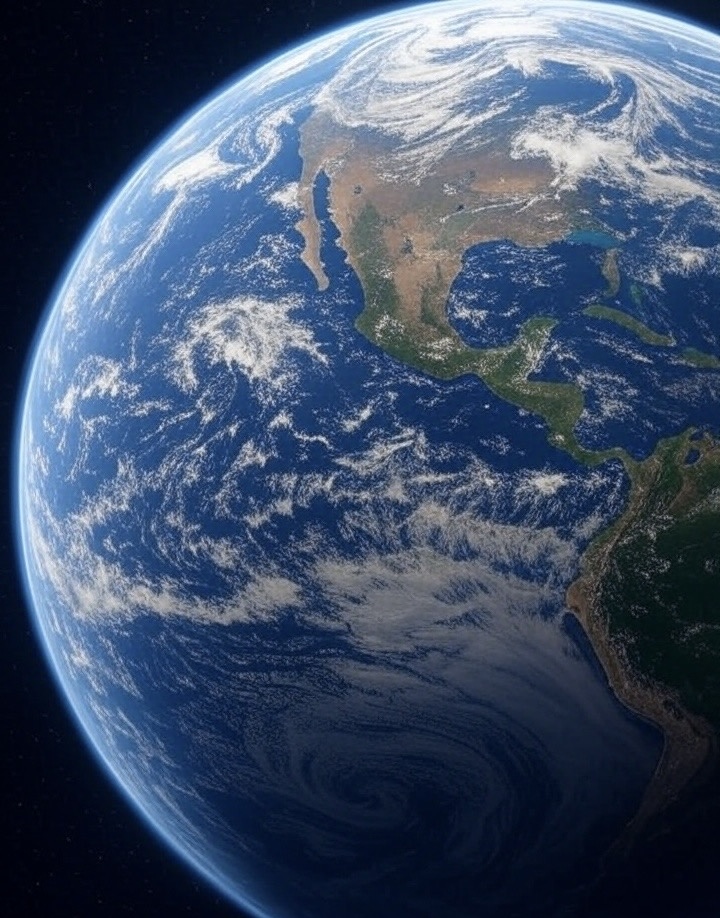
Elevating further to 50,000 feet, approaching the edge of the atmosphere where military reconnaissance aircraft operate, the entire planet appears as a fragile blue marble suspended in the void. National borders dissolve, human endeavors blend into geological epochs, and Earth becomes one node in a vast cosmic web. This perspective transcends terrestrial systems, embracing universal principles, existential questions, and the interplay of galaxies.
Neurologically, this altitude pushes the boundaries of human cognition, activating contemplative networks that ponder infinity, drawing on insights from quantum mechanics to cosmology. It questions not just paradigms but the nature of existence itself – the role of consciousness in the universe, the multiverse hypothesis, or the Fermi paradox asking where extraterrestrial life hides.
In scientific exploration, astrophysicists like Carl Sagan embodied this view in Cosmos (1980), portraying humanity as “star stuff” contemplating the stars, linking daily life to the Big Bang’s echoes. In philosophy, thinkers like Friedrich Nietzsche gazed here, proclaiming the death of God and urging humanity to create meaning in an indifferent cosmos.
Practically, this view informs space policy and long-term survival strategies. Organizations like the European Space Agency model asteroid deflection not for immediate threats (lower views) but for species-level extinction risks over millennia. In business, visionaries at this altitude, such as Jeff Bezos with Blue Origin, envision multi-planetary futures, seeing Earth-bound economies as temporary scaffolds.
Yet, pitfalls abound – existential dread or nihilism can emerge, where individual actions seem insignificant against cosmic timescales. Historical analogs include ancient astronomers overwhelmed by the heavens, leading to fatalistic worldviews.
To access this level, engage in cosmic meditation, study astrophysics, or participate in overview effect simulations (inspired by astronauts’ profound shifts upon seeing Earth from space). Tools like virtual reality planetariums or reading speculative fiction aid in bridging the abstract to the actionable.
The 199,000-Foot View – Universal Unity and Multiversal Potentials
Rising to 199,000 feet, nearing suborbital realms where the curvature of Earth dominates and the thin veil of atmosphere gives way to the vacuum, the solar system emerges as a harmonious dance of planets, asteroids, and comets orbiting a singular star. Galaxies swirl in the distance, and the universe reveals itself as an infinite realm of possibilities, potentially branching into multiverses. This perspective dissolves all boundaries, viewing reality as a unified field where time, space, and consciousness intertwine on scales beyond human lifespan.
Neurologically, this altitude challenges the limits of individual minds, invoking concepts of collective intelligence or simulated realities, perhaps akin to neural networks in advanced AI that model infinite scenarios. It delves into questions of ultimate origins: the Big Bang as one event in an eternal cycle, string theory’s hidden dimensions, or the simulation hypothesis positing existence as code in a higher computation.
In scientific frontiers, physicists like Stephen Hawking exemplified this view in *A Brief History of Time* (1988), exploring black holes not as isolated phenomena but as keys to understanding the fabric of spacetime across the cosmos. In speculative philosophy, figures like David Deutsch pioneer quantum computing from here, envisioning parallel universes where every decision spawns new realities.
Practically, this informs interstellar exploration and theoretical innovations. Initiatives like the Breakthrough Starshot project aim at propelling nanocraft to Alpha Centauri, framing humanity’s future not on one planet or system but across stars. In emerging fields, it drives discussions on post-humanism, where AI and biotechnology merge to extend consciousness into the void.
However, risks intensify: profound alienation or hubris, where overreaching theories ignore empirical grounding, echoing historical alchemists lost in esoteric pursuits. It can foster detachment so extreme that earthly responsibilities fade into irrelevance.
To reach this level, immerse in advanced simulations, quantum philosophy texts, or collaborative think tanks like the Santa Fe Institute. Practices such as lucid dreaming or psychedelic-assisted introspection (under guidance) can simulate the expansion, fostering insights that ripple back to lower altitudes.
Navigating the Altitudes – Fluid Shifts for Optimal Insight
The true power lies not in dwelling at one level but in fluid navigation across all five. Cognitive flexibility, the brain’s ability to switch perspectives, is key, bolstered by practices like neuroplasticity-enhancing activities (e.g., learning new skills or bilingualism).
Consider a case study: NASA’s Apollo program. Engineers at 0 feet designed hardware; program managers at 10,000 feet coordinated launches; visionaries like JFK at 30,000 feet inspired the moonshot as a symbol of human potential. Extending to 50,000 feet, modern successors like the Artemis program frame lunar bases as stepping stones to interstellar exploration; at 199,000 feet, concepts like warp drives envision traversing the galaxy.
In personal development, therapy often facilitates these shifts: from ruminating on daily stressors (0 feet) to identifying life patterns (10,000 feet) to redefining one’s purpose (30,000 feet) to contemplating legacy in the cosmic narrative (50,000 feet) to embracing multiversal self-actualization (199,000 feet).
Challenges arise in mismatched views – e.g., micromanaging bosses stuck at 0 feet stifling innovation, or dreamers lost at 199,000 feet ignoring practicalities. Solutions include “zoom meetings” (literal or figurative) where teams deliberately alternate altitudes.
As global, cosmic, and multiversal challenges like AI ethics, pandemics, interstellar threats, or reality simulations are faced, mastering these shifts is imperative. The 0-foot view grounds in empathy; 10,000 feet in strategy; 30,000 feet in wisdom; 50,000 feet in transcendence; 199,000 feet in unity. By oscillating between them, the full spectrum of human insight is harnessed.
Closing Thought – Embracing the Eternal Ascent
Perspectives are not fixed points, but dynamic trajectories, inviting perpetual motion between the intimate and the infinite. Do not remain anchored eternally to the ground, nor drift without purpose through the clouds, the stars, or the boundless void. Instead, ascend with intention, descend with reflection, and discover equilibrium in the flux. Each altitude offers not merely a vista but a transformative lens, reframing reality and revealing hidden depths of potential. As horizons expand, so too does the capacity for innovation, empathy, and understanding—reminding that the true journey lies in the shifts themselves, ever evolving toward greater enlightenment. What, then, beckons as the next ascent in this unending exploration?
NeuralRotica has long been fascinated by the neural underpinnings of these mindset shifts – how brains rewire to accommodate broader horizons, and what is gained (or lost) in the process.
 NeuralRotica