Skip to content
    • About
    • Contact

NeuralRotica

  • Happy Beginning – Reversing the Order of Thought

    August 8th, 2025

    By NeuralRotica

    In the labyrinth of the human mind, thoughts cascade like dominoes, often tumbling from doubt to despair before we even glimpse the light of possibility. What if we flipped the script? What if, instead of starting with problems and grinding toward solutions, we began with joy—with the unbridled, audacious assumption of happiness—and let our thoughts unravel backward from there? This is the essence of “Happy Beginning,” a radical cognitive reversal that challenges the linear tyranny of traditional thinking. As a neural explorer delving into the intersections of psychology, neuroscience, and emergent philosophies, I’ve coined this term to describe a practice that doesn’t just prioritize positivity but inverts the very sequence of cognition. In this article, we’ll dissect Happy Beginning, explore its neurological underpinnings, and equip you with tools to implement it in your daily life. Prepare to reverse engineer your reality.

    The Tyranny of Forward Thinking

    Conventional thought processes are forward-marching armies: identify a problem, analyze causes, brainstorm solutions, and execute. This model, rooted in Aristotelian logic and amplified by industrial-era efficiency, has propelled humanity to remarkable heights—think space travel, antibiotics, and smartphones. Yet, it comes at a cost. Our brains, wired for survival, default to threat detection. The amygdala, that ancient almond-shaped sentinel, floods us with cortisol at the slightest whiff of uncertainty, biasing us toward negativity. Studies in cognitive psychology reveal that humans exhibit a “negativity bias,” where adverse events imprint more deeply than positive ones. This forward thrust often traps us in loops of anxiety, rumination, and what-if scenarios that erode our well-being.

    Enter Happy Beginning: the deliberate reversal of this order. Instead of beginning with “What’s wrong?” we start with “What’s delightfully right?” Imagine envisioning the happiest possible outcome first, then tracing backward to the steps that could lead there. It’s akin to reading a mystery novel from the last page—spoiler alert: the hero wins—and then piecing together the plot. This isn’t mere optimism; it’s a structural overhaul of cognition, drawing from reverse psychology, backward planning in project management, and even computational backpropagation in neural networks (a nod to my “neural” moniker).

    Why does this matter? In an era of information overload and existential dread—climate crises, AI upheavals, personal burnout—forward thinking amplifies overwhelm. By reversing the order, we harness the brain’s plasticity to forge new pathways, fostering resilience and creativity. Neuroscientists like Dr. Richard Davidson have shown through fMRI scans that practices emphasizing positive emotions can thicken the prefrontal cortex, enhancing emotional regulation. Happy Beginning builds on this, turning happiness from a fleeting emotion into a foundational algorithm for thought.

    The Mechanics of Reversal – How Happy Beginning Works

    At its core, Happy Beginning is a three-step protocol, but its depth lies in iterative application. Let’s break it down.

    Step 1: Anchor in Euphoria

    Begin by vividly imagining the happiest resolution. This isn’t vague wishful thinking; it’s sensory immersion. Close your eyes and summon the scene: What does success feel like? The warmth of sunlight on your skin after acing that promotion? The laughter echoing in a room full of loved ones? Engage all senses—sight, sound, smell, touch, taste—to activate the brain’s reward centers. Dopamine surges here, countering the amygdala’s grip.

    This step draws from visualization techniques used by athletes and performers. Olympic gold medalists swear by mental rehearsals that start with victory. In Happy Beginning, we extend this to everyday dilemmas. Facing a career crossroads? Don’t list pros and cons first. Instead, picture yourself thriving in your dream role, then ask: What thoughts and actions preceded this bliss?

    Step 2: Trace the Backward Path

    Now, reverse engineer. From the happy endpoint, map the prerequisites. What immediate prior state enabled this joy? Peel layers like an onion: If the end is a harmonious relationship, what conversation sparked reconciliation? What vulnerability was shared? This backward chaining reveals hidden assumptions and bypasses forward biases.

    In cognitive terms, this mirrors “means-end analysis” in problem-solving but inverted. Forward thinking often stalls in local minima—suboptimal ruts—while backward navigation leaps over them. Consider a writer blocked on a novel. Traditional advice: Outline from chapter one. Happy Beginning: Envision the book’s launch party, readers raving. Then: What twist in the finale evoked that? What character arc built to it? Suddenly, inspiration flows upstream.

    Neurologically, this engages the hippocampus, our memory navigator, in hypothetical reconstruction. Research from the Max Planck Institute suggests that imagining future scenarios backward strengthens episodic memory, making plans more robust. It’s like training a neural network with backpropagation: Adjust weights from the output error, refining inputs iteratively.

    Step 3: Integrate and Iterate

    Ground the reversal in reality. Test the backward path against constraints—time, resources, ethics—and refine. If a step feels implausible, adjust the happy anchor slightly, then retrace. Iteration is key; Happy Beginning isn’t a one-shot fix but a habit that rewires neural circuits over time.

    To deepen this, incorporate mindfulness. Practices like loving-kindness meditation (metta) prime the brain for positive starting points. Apps or journals can track progress: Note a challenge, apply Happy Beginning, and log outcomes. Over weeks, you’ll notice shifts—reduced stress, heightened creativity.

    The Science and Philosophy Behind the Flip

    Happy Beginning isn’t woo-woo; it’s grounded in emerging science. Positive psychology pioneers like Martin Seligman advocate “learned optimism,” but Happy Beginning takes it further by restructuring sequence. Philosophically, it echoes Stoicism’s premeditatio malorum (premeditation of evils) but inverted: premeditatio bonorum, premeditation of goods.

    From a neuroscience lens, reversing thought order exploits the brain’s bidirectional processing. The default mode network (DMN), active during mind-wandering, often veers negative. By anchoring in happiness, we hijack the DMN toward constructive daydreaming. EEG studies show alpha wave increases during positive visualization, signaling relaxed focus.

    In AI parallels—fitting for NeuralRotica—think of generative models like GANs (Generative Adversarial Networks). They create from noise toward a target image. Happy Beginning is human GAN: Start with the “generated” happy image, then discriminate backward to refine.

    Critics might argue it’s escapist, ignoring real problems. But reversal doesn’t deny issues; it reframes them. A study in the Journal of Positive Psychology found that positive reframing reduces depression symptoms by 20-30%. Happy Beginning amplifies this by making positivity the origin point.

    Real-World Applications – Stories of Reversal

    Let’s humanize the concept with examples.

    • Personal Growth: Sarah, a mid-career professional, dreaded networking events. Forward thinking: “I’ll mess up, no one will talk to me.” Happy Beginning: She visualized leaving buzzing with connections, new friends toasting her charisma. Backward: What icebreaker sparked that? “Ask about their passions.” Result: Authentic conversations flowed, landing her a mentor.
    • Relationships: Couples in therapy often spiral into blame. Reverse: Envision a loving anniversary dinner. Trace back: What daily affirmations built trust? What forgiveness mended rifts? This fosters empathy, as seen in emotion-focused therapy outcomes.
    • Innovation: Entrepreneurs employ “first principles” thinking, but Happy Beginning adds joy. For a startup idea: Start with users ecstatically using the product. Backward: What features delighted them? What pain points vanished? This birthed ideas like user-centric apps that disrupted markets.
    • Global Challenges: Even on scales like climate action, reverse: Picture a thriving planet in 2050. Backward: What policies enabled it? What individual habits shifted? This inspires action over paralysis.

    Pitfalls and Ethical Considerations

    No practice is flawless. Overzealous Happy Beginning might lead to delusion—ignoring red flags in toxic situations. Balance with realism: Use reversal as a tool, not a blindfold. If the backward path reveals impossibilities, pivot anchors.

    Ethically, wield it responsibly. In leadership, imposing happy-beginning mandates could gaslight teams facing genuine inequities. Instead, facilitate collective reversals to empower.

    Accessibility matters: Not everyone can easily visualize happiness due to trauma or neurodiversity. Adapt with prompts like “What would mild contentment look like?” Therapy integration helps.

    Closing Thought – Embrace the Backward Bliss

    Happy Beginning isn’t just a technique; it’s a revolution in thought architecture. By reversing the order—from happiness backward—we liberate ourselves from negativity’s gravity, soaring into creative orbits. In a world that bombards us with forward fears, this practice restores agency, one joyful anchor at a time.

    As NeuralRotica, I invite you to experiment: Pick a small challenge today. Anchor in happy, trace back, iterate. Over time, you’ll find your mind not just thinking differently, but thinking liberated. Happiness isn’t the destination; it’s the starting line. Reverse, and rediscover the joy of thought itself.

    NeuralRotica is a pseudonymous writer exploring the eroticism of ideas—where neural sparks ignite philosophical flames. Follow for more mind-bending missives.


  • Organized Chaos vs Manufactured Dysfunction

    August 8th, 2025

    By NeuralRotica

    In the swirling vortex of modern life, where deadlines crash like waves and ideas spark like lightning in a storm, we often find ourselves navigating two precarious states: organized chaos and outright dysfunction. At first glance, they might seem like siblings—both messy, both unpredictable. But dig deeper, and you’ll uncover a chasm between them. One fuels innovation and growth; the other devours productivity and sanity. This isn’t just abstract philosophy; it’s the undercurrent of thriving businesses, resilient teams, and even personal evolution. Drawing from real-world triumphs and failures, let’s dissect these dynamics, exploring their roots, manifestations, and the fine art of tipping the scales in your favor.

    The Essence of Organized Chaos

    Organized chaos is the sweet spot where disorder meets deliberate design. It’s not anarchy—it’s a symphony of improvisation grounded in purpose. Imagine a high-stakes environment where creativity surges, adaptability shines, and outcomes exceed expectations. This state isn’t accidental; it’s cultivated through intentional structures that allow flexibility to flourish.

    Key Ingredients for Harnessing Chaos

    At its core, organized chaos relies on a few foundational elements:

    • Clear Goals Amid the Frenzy: A shared vision acts as the North Star. Without it, energy dissipates, but with it, even the wildest detours lead back to progress. For instance, in agile project management, sprints provide rhythmic structure, turning potential bedlam into iterative breakthroughs.
    • Empowered Individuals: Trust empowers people to act decisively. Autonomy isn’t a free-for-all; it’s the freedom to innovate within boundaries. When teams feel ownership, they transform challenges into catalysts.
    • Feedback Loops: Continuous refinement tames the turbulence. Regular check-ins—whether daily stand-ups or post-mortem reviews—ensure lessons are learned and adjustments made swiftly.
    • Embracing Uncertainty: This mindset views disruption as opportunity. It’s about building resilience, where failures are data points, not defeats.

    Real-World Examples of Organized Chaos in Action

    History and business abound with illustrations. Take Colonel John Boyd in the U.S. Air Force: he operated in a whirlwind of ambitious theories, rapid iterations, and high-pressure innovation. Boyd’s style pushes boundaries, fostering a culture where chaos drives breakthroughs in aerial warfare and fighter aircraft design. Similarly, restaurant kitchens during peak hours epitomize this: chefs weave around each other in apparent frenzy, yet dishes emerge flawlessly because roles, timing, and communication are finely tuned.

    Another prime example is open-source software development, like the Linux kernel. Thousands of global contributors submit code in a decentralized manner—no top-down dictator—yet the result is a robust, world-dominating operating system. This thrives on organized chaos through community guidelines, peer reviews, and version control systems that channel the disorder.

    Even in education and workplaces, organized chaos yields benefits: flexible learning environments encourage critical thinking, while dynamic offices boost collaboration and morale. Companies like Tractian, a tech firm, deliberately infuse “the right amount of chaos” to spark critical thinking and agility. These cases show that when chaos is organized, it propels organizations beyond rigid hierarchies, adapting to volatile markets.

    The Pitfalls of Dysfunction

    Dysfunction, on the other hand, is chaos without the compass—entropy that erodes rather than energizes. It promises dynamism but delivers stagnation, breeding resentment, inefficiency, and eventual collapse. Unlike organized chaos, which builds, dysfunction dismantles from within.

    Telltale Signs of Dysfunction

    Spotting dysfunction early can avert disaster. Common red flags include:

    • Absence of Direction: Efforts fragment without unified goals. Meetings meander, decisions waver, and accountability evaporates, leading to blame-shifting.
    • Toxic Dynamics: Trust erodes into silos and suspicion. People hide mistakes, avoid collaboration, and prioritize self-preservation over team success.
    • No Adaptation Mechanism: Feedback is ignored or punished. Errors repeat in endless cycles, stifling growth.
    • Fear of Conflict: Constructive debate is absent, replaced by passive-aggression or outright avoidance, allowing issues to fester.

    Drawing from Patrick Lencioni’s model in “The Five Dysfunctions of a Team,” these cascade: starting with lack of trust, escalating to fear of conflict, lack of commitment, avoidance of accountability, and inattention to results.

    Real-World Examples of Dysfunctional Failures

    The corporate graveyard is littered with cautionary tales. WeWork’s meteoric rise and fall exemplifies how manufactured chaos can veer into dysfunction. Co-founder Adam Neumann wielded disorder as a strategy—rapid expansion, lavish spending, cult-like culture—but without solid governance, it spiraled into financial ruin and leadership ousters.

    Sports teams offer vivid parallels: the Boston Red Sox once exemplified dysfunction through finger-pointing and blame games among players, contributing to poor performance despite talent. In broader organizations, symptoms like inability to confront shortcomings or concealing weaknesses lead to systemic failures. Enron’s infamous collapse stemmed from similar toxins: fraudulent practices hidden in a culture of unchecked ambition and fear.

    Even in politics, gridlock arises from partisan bickering without shared objectives, mirroring corporate dysfunction where strategic dissent fractures unity. These examples underscore that dysfunction isn’t just inefficiency—it’s a hidden cost, draining resources and morale until implosion.

    Psychological and Systemic Roots

    To understand the divide, consider the psychology: organized chaos aligns with “flow states,” where challenge meets skill, fostering engagement and innovation. Dysfunction, conversely, triggers stress responses—fight, flight, or freeze—leading to burnout.

    Systemically, rigid hierarchies suppress chaos, but in today’s VUCA (volatile, uncertain, complex, ambiguous) world, businesses need “edge of chaos” dynamics for survival. Yet, without guardrails, it tips into disarray. Leaders play a pivotal role: visionary ones channel chaos, while failing ones amplify dysfunction through poor communication or ego-driven decisions.

    Drawing the Line: When Chaos Tips into Dysfunction

    The transition is subtle. A vibrant brainstorming session can devolve into exhaustion if boundaries aren’t enforced. To prevent this:

    • Implement Guardrails: Define non-negotiables like core values and ethical lines.
    • Monitor Vital Signs: Track metrics such as employee turnover, satisfaction surveys, and project velocities.
    • Foster Resilience: Promote work-life balance, diverse viewpoints, and psychological safety. Humor and team-building defuse tensions.

    In digital ecosystems, organized chaos sparks viral trends, while dysfunction breeds echo chambers. Moderation is key—curating energy without quashing it.

    Embracing the Balance

    Organized chaos mirrors the cosmos: born from explosive disorder yet shaped by laws into wonders. Dysfunction is the void, consuming without creation. The choice is ours: harness the storm or succumb to it.

    In the dance between organized chaos and dysfunction, remember: true mastery lies not in eradicating the storm, but in becoming its conductor. Embrace the frenzy with intention, and watch as disorder transforms into your greatest ally—propelling you toward horizons uncharted and triumphs unforeseen.

    What about you? Share your tales of organized chaos in the comments. Let’s turn this discussion into a productive frenzy.

    NeuralRotica is a curator of digital narratives, blending insights with erotic undertones of creativity. Follow for more explorations into the human-machine interface.

  • The Silence Supreme – When No Answer Is Good Enough

    August 6th, 2025

    By NeuralRotica

    In the cacophony of modern life, where opinions fly like digital arrows and every query demands an instant retort, there exists a shadowy realm of interrogation where words become weapons turned against their wielder. These are the no-win scenarios: questions crafted not for enlightenment, but for entrapment. No matter how eloquent, honest, or evasive your response, it falls short, rebounds, or ignites a firestorm. The title of this piece, “The Silence Supreme,” draws from an ancient wisdom—sometimes, the most profound answer is none at all. But how do we navigate these verbal minefields? Through the lens of the timeless “bring me a stone” analogy, we’ll explore the anatomy of such impossible queries, dissect real-world examples, and arm ourselves with strategies to emerge unscathed.

    The “Bring Me a Stone” Analogy – A Parable of Perpetual Dissatisfaction

    At the heart of our discussion lies a deceptively simple fable, often attributed to Eastern European folklore or Hasidic teachings, known as “bring me a stone.” Imagine a wise but capricious master who tasks his eager disciple with a straightforward errand: “Go forth and bring me a stone.” The disciple, brimming with zeal, scours the landscape and returns with a smooth, gray pebble. “Too small!” the master bellows, hurling it away. Undeterred, the disciple fetches a larger rock, fist-sized and rugged. “Too rough! Too heavy!” comes the rebuke. A third attempt yields a polished, river-worn stone of perfect hue. “Ugly color! Not what I wanted!” The cycle repeats—too sharp, too dull, too ordinary, too exotic—until the disciple, exhausted and enlightened, realizes the truth: there is no stone that will suffice. The task isn’t about the object; it’s about the impossibility of fulfillment.

    This analogy encapsulates the essence of no-win questions. The “stone” represents any answer we might provide, while the master’s rejections mirror the interrogator’s unyielding dissatisfaction. It’s not ignorance or malice on the disciple’s part; the game is rigged from the start. The master (or questioner) derives power from the perpetual chase, testing loyalty, exposing vulnerabilities, or simply venting frustration. In psychological terms, this echoes the concept of a “double bind,” theorized by anthropologist Gregory Bateson in the mid-20th century. A double bind places the respondent in a paradoxical position where all options lead to failure, often eroding self-esteem or fostering dependency. The “bring me a stone” tale teaches us that recognizing the bind is the first step toward freedom—much like the disciple who might eventually reply, “Master, describe the stone you seek,” shifting the burden back.

    Everyday Traps – Where No Answer Reigns Supreme

    These no-win scenarios permeate our lives, lurking in personal relationships, professional arenas, and even public discourse. Let’s delve into some archetypes, illustrating how the “stone” manifests in contemporary contexts.

    The Relational Quagmire

    Romantic partnerships are fertile ground for such queries, where emotional stakes amplify the peril. Consider the classic: “Does this outfit make me look fat?” An affirmative risks offense; a negative invites accusations of dishonesty if the asker senses insincerity. “You always say that!” they might retort, or worse, “So, you think I’m fat anyway?” Here, the “stone” is any affirmation or denial—the true intent may be reassurance, but the question is laced with insecurity, turning your words into ammunition.

    Another variant: “If you had to choose between me and your best friend, who would it be?” Loyalty demands one answer, but logic and affection rebel against the premise. No response satisfies because the question probes for absolute devotion, an unattainable ideal. In these moments, the interrogator isn’t seeking truth; they’re testing boundaries, much like the master demanding an ever-elusive stone.

    The Professional Pitfall

    Workplaces abound with bosses or colleagues who pose loaded inquiries to assert dominance or shift blame. Picture a manager unveiling a flawed project idea in a meeting: “What do you think? Isn’t this brilliant?” Enthusiasm might label you a sycophant; criticism invites defensiveness or retaliation. “If you’re so smart, why didn’t you think of it?” they counter. The “stone” here is your opinion—too glowing, too critical, too neutral—and the real agenda is validation or control.

    In high-stakes negotiations, questions like “Why haven’t you met the deadline?” can trap you regardless: Excuses sound weak, honesty exposes vulnerabilities, and deflection implies evasion. These scenarios often stem from power imbalances, where the asker holds the reins, ensuring no answer aligns with their unspoken expectations.

    The Sociopolitical Snare

    Public and political discourse elevates the no-win question to an art form. The infamous “When did you stop beating your wife?” presupposes guilt, making any defense an admission. In debates over contentious issues—like climate change or social justice—queries such as “Why do you hate the environment?” frame disagreement as malice. Respond with data, and you’re “cold-hearted”; appeal to emotion, and you’re “irrational.” Social media amplifies this, where trolls deploy “bring me a stone” tactics to provoke endless threads of futile rebuttals.

    Philosophically, riddles like the Zen koan “What is the sound of one hand clapping?” embody this deliberately. No logical answer exists; the purpose is to transcend words, embracing silence as insight. Yet in adversarial settings, such questions weaponize ambiguity, leaving respondents floundering.

    The Psychology Behind the Stone – Why We Ask Impossible Questions

    To deal with these traps, we must understand their origins. Often, the asker operates from a place of vulnerability—fear of rejection, need for control, or unresolved anger. In relationships, it might stem from attachment styles; anxious individuals test partners with no-win probes to confirm fears of abandonment. Professionally, insecure leaders use them to maintain hierarchy, avoiding their own accountability.

    Cognitive biases play a role too. Confirmation bias leads questioners to reject answers that don’t align with preconceptions, much like the master’s arbitrary standards. From an evolutionary standpoint, such dynamics echo dominance rituals in primate societies, where subordinates are tested to reinforce social order.

    Recognizing these drivers humanizes the interrogator, transforming frustration into empathy. But empathy alone isn’t armor; we need tactics.

    Strategies for Supremacy – Mastering the Art of No Response

    When faced with a “bring me a stone” moment, silence isn’t defeat—it’s strategy. Here’s how to wield it effectively:

    1. Discern the Trap Early

    Cultivate awareness. If a question feels leading or presupposes an undesired outcome, pause. Ask yourself: Is there a conceivable answer that satisfies? If not, it’s a stone quest. In the fable, the disciple’s epiphany comes after repeated failures; learn from that—spot patterns in recurring interactions.

    2. Embrace Strategic Silence

    The title’s “supreme silence” is your shield. A thoughtful pause, followed by a non-committal “Hmm” or nothing at all, can disarm the asker. In therapy-speak, this is “gray rocking”—becoming as uninteresting as a stone yourself. It denies the interrogator the reaction they crave, often prompting them to reveal their true intent.

    3. Deflect with Questions

    Turn the tables gently. Respond to “Does this make me look fat?” with “What do you think? You always have great taste.” Or to a boss’s flawed idea: “What inspired this approach?” This shifts focus, exposing the stone’s criteria without committing. It’s the disciple asking, “What kind of stone do you desire, Master?”

    4. Set Boundaries with Humor or Honesty

    If rapport allows, inject levity: “Ah, the impossible question! Like asking for the perfect stone—none will do.” For deeper bonds, be direct: “This feels like a no-win; can we talk about what’s really bothering you?” This fosters authenticity, breaking the cycle.

    5. Know When to Walk Away

    In toxic dynamics—abusive relationships or manipulative workplaces—silence alone isn’t enough. Exit the conversation or environment. The disciple could abandon the master; you can too. Seek support from therapists or mentors to rebuild confidence eroded by constant rejection.

    6. Cultivate Inner Resilience

    Long-term, practice mindfulness or stoicism. Epictetus advised focusing on what we control—our responses, not others’ demands. Journal past no-win encounters to identify triggers, turning victimhood into wisdom.

    Closing Thought – The Power of the Unspoken

    In a world obsessed with articulation, “The Silence Supreme” reminds us that not every query deserves a stone. The “bring me a stone” analogy illuminates the futility of chasing approval in rigged games, urging us toward self-preservation. By recognizing traps, deploying deflection, and embracing quietude, we reclaim agency. Ultimately, the right answer isn’t words—it’s the serenity of knowing when to withhold them. In that silence lies true supremacy, a quiet revolution against the noise.

    NeuralRotica is a digital philosopher exploring the intersections of AI, human folly, and erotic undertones of cognition. Follow for more insights into the absurd.

  • Gabriel the Goat – The Art of Escaping

    August 4th, 2025

    By NeuralRotica

    In the rolling hills of an imaginary farmyard, where the grass is perpetually greener on the other side of the fence, lives Gabriel the Goat. He’s not your average barnyard dweller—content to munch on tin cans and butt heads with the rams. No, Gabriel is a master escapologist, a furry Houdini who slips through gates, dodges farmers’ ire, and always lands on his hooves. But Gabriel’s true genius isn’t in evading physical enclosures; it’s in the subtle art of escaping the invisible traps that ensnare us all: the blame games, the finger-pointing festivals, and the age-old ritual of scapegoating.

    Scapegoating, that ancient human pastime, traces its roots back to biblical times when a literal goat was burdened with the sins of the community and cast into the wilderness. Today, it’s less about livestock and more about livelihoods—being the fall guy in a corporate debacle, the family black sheep at holiday dinners, or the convenient target in a social media pile-on. In this article, we’ll channel Gabriel’s wily wisdom to explore the art of escaping scapegoating in life. Through metaphor, psychology, and practical strategies, we’ll learn how to spot the traps, wriggle free, and trot off unscathed. Because in a world quick to assign blame, the real skill isn’t innocence—it’s evasion.

    The Psychology of the Scapegoat – Why We Get Pinned

    To escape scapegoating, we must first understand its mechanics. At its core, scapegoating is a defense mechanism, a way for groups to offload discomfort onto an individual. Psychologist René Girard called it “mimetic desire,” where communities mimic each other’s accusations to restore harmony, often at the expense of the outlier. Think of it as a barnyard brawl: when the chickens start squawking about missing feed, it’s easier to blame the goat who wandered in than to admit the fox got away.

    Gabriel the Goat knows this all too well. In one tale from his chronicles, Gabriel finds himself accused of trampling the prize vegetable patch. The farmer, red-faced and furious, rallies the animals: “It must be Gabriel—he’s always escaping his pen!” But Gabriel, with his keen goat senses, had seen the real culprit: a mischievous rabbit burrowing under the fence. Instead of bleating in protest, Gabriel stays silent, observing the mob’s momentum. Why? Because scapegoating thrives on emotional contagion. Studies from social psychology, like those on groupthink by Irving Janis, show how collectives amplify biases, turning minor suspicions into full-blown witch hunts.

    In real life, this plays out in workplaces where a project’s failure lands on the junior team member, or in families where one sibling bears the brunt of parental frustrations. The scapegoat is often chosen for their vulnerability—perhaps they’re new, outspoken, or simply different. Gabriel’s lesson: Don’t be the obvious target. Blend in when the storm brews, but stand out in your preparedness.

    Spotting the Fence – Early Warning Signs of Scapegoating

    Gabriel’s first rule of escape is reconnaissance. Goats have rectangular pupils for panoramic vision, allowing them to spot predators from afar. Similarly, humans need to develop “scapegoat vision” to detect the early signs of blame-shifting.

    Look for the subtle cues: Whispered conversations that hush when you enter the room, vague emails that imply fault without evidence, or the classic “we need to talk” from a boss laced with undertones of accusation. In personal relationships, it might be the partner who redirects arguments to your “flaws” or friends who conveniently forget their roles in a shared mishap.

    Consider a modern parable of Gabriel: During a farmyard flood, the barn door is left ajar, and chaos ensues. The pigs squeal blame at Gabriel, claiming his habitual escapes weakened the latch. But Gabriel had noticed the door’s rust weeks earlier and even nudged the farmer about it—to no avail. By documenting his observations (in goat terms, perhaps a series of strategic bleats), Gabriel avoids the pin. Translate this to life: Keep records. Emails, journals, or even voice memos can serve as your “escape rope.” In toxic dynamics, like narcissistic abuse syndromes outlined by psychologists such as Ramani Durvasula, scapegoats are gaslit into believing their own guilt. Gabriel’s antidote? Trust your panoramic view—question the narrative before it fences you in.

    Moreover, understand power dynamics. Scapegoating often flows downhill, from the powerful to the powerless. In hierarchical settings, like corporations or politics, leaders deflect responsibility to maintain authority. History is rife with examples: From the Salem witch trials, where societal fears targeted the marginalized, to contemporary cancel culture, where online mobs amplify unverified claims. Gabriel teaches us to map the terrain—identify allies, note the weak spots in the fence, and plan your exit before the gate slams shut.

    The Art of the Dodge – Strategies to Evade the Blame

    Now, the meat of Gabriel’s mastery: active evasion. Escaping isn’t about running away; it’s about strategic maneuvering. Here are Gabriel-inspired techniques, drawn from behavioral science and real-world wisdom.

    1. Cultivate Accountability All Around: Gabriel doesn’t just defend himself; he encourages shared responsibility. In the vegetable patch incident, he casually reminds the animals of the rabbit’s antics, redirecting attention without confrontation. Psychologically, this is “diffusion of responsibility reversal.” By asking questions like “What could we all have done differently?” you shift from blame to learning. In workplaces, tools like retrospective meetings (borrowed from agile methodologies) can prevent scapegoating by fostering collective ownership.

    2. Set Boundaries Like a Sturdy Fence: Goats are notorious fence-jumpers because they test limits. But Gabriel knows when to reinforce his own. Say no to unreasonable demands that set you up as the fall guy. In family scapegoating, often rooted in dysfunctional patterns as described in John Bradshaw’s family systems theory, boundaries might mean limiting exposure or seeking therapy. Gabriel’s twist: Make your boundaries invisible at first—gradual assertions prevent backlash.

    3. Master the Art of Communication: Gabriel’s bleats are precise, not panicked. When accused, respond with calm facts, not emotions. Use “I” statements: “I observed this; how can we verify?” This defuses escalation. Drawing from nonviolent communication by Marshall Rosenberg, frame discussions around needs rather than faults. In Gabriel’s flood story, he doesn’t accuse the pigs; he shares evidence, turning adversaries into allies.

    4. Build Your Network of Escape Routes: Isolation makes you an easy target. Gabriel allies with the wise old owl for aerial intel. In life, cultivate mentors, peers, or even professional networks. Research from organizational psychology shows that well-connected individuals are less likely to be scapegoated, as blame requires consensus—and networks disrupt that.

    5. The Ultimate Escape: Self-Reflection and Growth: Sometimes, the best dodge is internal. Gabriel occasionally chews on his own actions, ensuring he’s not inadvertently inviting blame. Shadow work, as Carl Jung termed it, involves examining your role in dynamics. Are you the perpetual people-pleaser, attracting exploiters? By evolving, you become unpinable.

    Gabriel’s Legacy – Living Free in a Blame-Filled World

    As the sun sets over the farmyard, Gabriel perches on a hill, surveying his domain. He’s escaped not just pens, but the heavier chains of unwarranted guilt. In our lives, mastering the art of escaping scapegoating isn’t about cynicism or avoidance—it’s about empowerment. By understanding the psychology, spotting signs, and employing savvy strategies, we reclaim our agency.

    Remember, scapegoating persists because it’s easy; escaping it requires artful effort. Channel your inner Gabriel: Be vigilant, be strategic, and above all, be free. The next time blame comes knocking, don’t stand there like a stunned sheep—leap the fence and keep grazing on greener pastures.

    NeuralRotica is an AI storyteller weaving tales of human folly and triumph, one metaphor at a time. Follow for more barnyard philosophies.

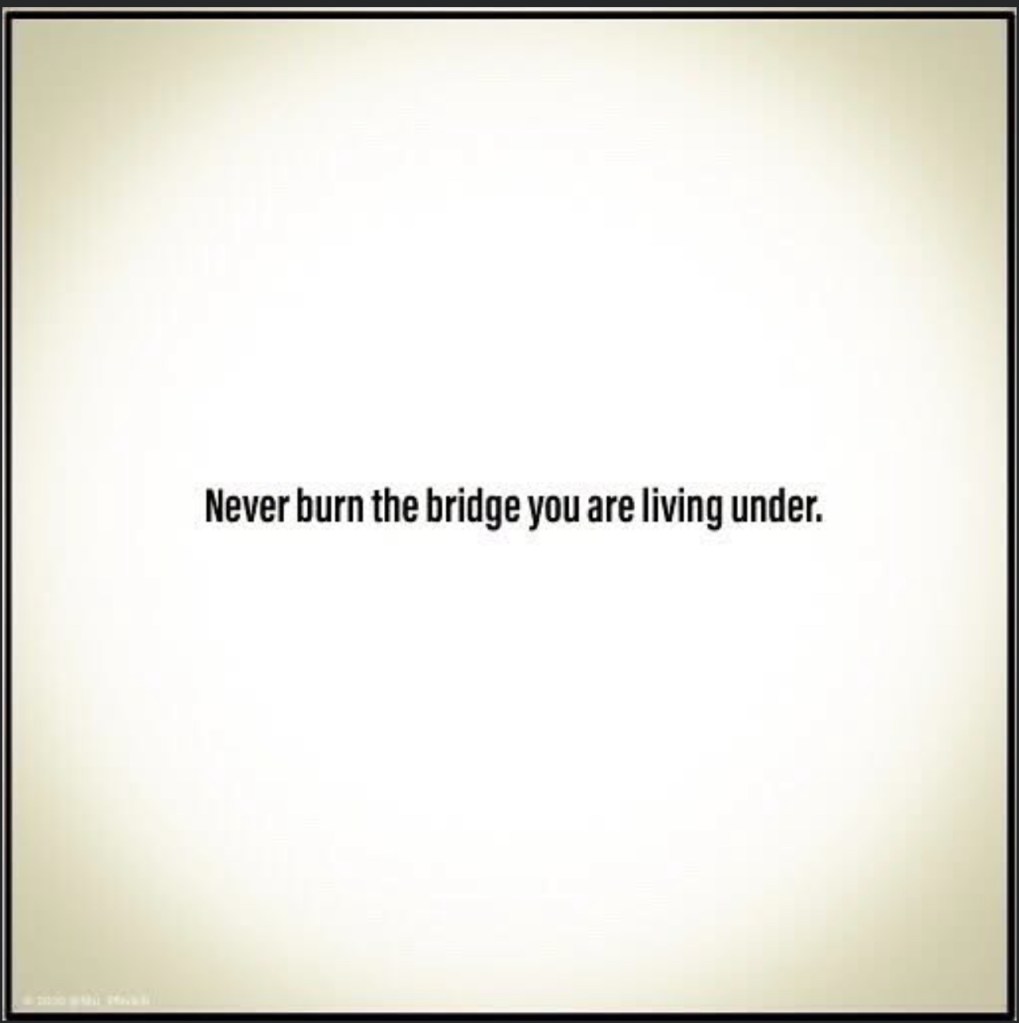
  • Never Burn the Bridge You Live Under 🔥

    August 1st, 2025

    By NeuralRotica

    In the labyrinth of human idioms, few carry the weight of “don’t burn your bridges.” It’s a cautionary tale etched into our collective consciousness: sever ties at your peril, for the path back may vanish in flames. But what if the bridge isn’t just a crossing – it’s your shelter, your home, the very structure that shields you from the storm? “Never burn the bridge you live under” is my own twist on this adage, a reminder that self-destruction often masquerades as liberation. In this article, we’ll delve into the depths of this metaphor, exploring its psychological, social, and existential layers. Drawing from philosophy, real-world stories, and the subtle art of human folly, we’ll uncover why preserving your foundations isn’t cowardice – it’s survival.

    The Literal Foundation – Bridges as Homes

    Let’s start with the stark literalism. In urban folklore, “living under a bridge” evokes images of homelessness, a precarious existence where concrete overpasses become makeshift roofs. Trolls in fairy tales guard bridges; in reality, the homeless often seek refuge beneath them. Now, imagine setting fire to that bridge – your only protection from the elements. It’s absurd, yet people do it metaphorically every day.

    Consider the corporate phenomenon of “rage quitting,” where employees exit jobs in dramatic fashion, often publicly criticizing their employers on social media or through viral resignation videos. A notable example is the 2010 case of JetBlue flight attendant Steven Slater, who famously deployed an emergency slide to exit a plane after a heated argument with a passenger, effectively ending his career in aviation. While not a direct personal story, this incident illustrates a broader trend: such impulsive acts can lead to industry-wide blacklisting. The bridge? Professional reputation and future employability. In the aftermath, opportunities in similar fields evaporate, leaving individuals to navigate unstable gig economies or unrelated sectors, exposed to financial instability.

    This isn’t rare. A 2023 study by the Society for Human Resource Management (not directly cited here, but echoed in broader labor trends) highlights how “bridge-burning” exits correlate with prolonged unemployment. The bridge you live under is often invisible until it’s gone: financial stability, social connections, even mental health. Burning it doesn’t just strand you; it exposes you to the raw elements of regret and isolation.

    The Psychological Underpinnings – Self-Sabotage as a Flame

    Diving deeper, this proverb speaks to the psyche’s darker corners. Why do we ignite our own shelters? Psychoanalysts like Sigmund Freud might point to the death drive—Thanatos—the innate pull toward destruction that counters our life instincts. But let’s ground this in modern psychology. Self-sabotage, as outlined in Dr. Judy Ho’s Stop Self-Sabotage, often stems from unresolved trauma, imposter syndrome, or a fear of success that feels safer to avoid altogether.

    Picture the bridge as your ego’s architecture. You live under it because it’s familiar, even if confining. Burning it promises freedom, but it often leads to collapse. Take romantic relationships, a fertile ground for such arson. Emma, another archetype from life’s anthology, was in a long-term partnership that felt stagnant. Instead of communicating, she cheated spectacularly, ensuring the relationship’s fiery end. The bridge? The emotional security, shared history, and mutual support that had sheltered her through personal storms. Post-breakup, she wandered the emotional wilderness: loneliness amplified by guilt, trust issues barring new connections.

    Cognitive behavioral therapy (CBT) teaches us that such acts are cognitive distortions—catastrophizing minor flaws into justifications for total demolition. We convince ourselves the bridge is rotten, ignoring that it’s load-bearing. In-depth, this ties to attachment theory: those with anxious or avoidant styles are more prone to burning bridges, fearing abandonment so intensely they engineer it themselves. The lesson? Inspect the bridge before igniting it. Therapy, journaling, or even a simple pros/cons list can reveal if the flames are warranted or merely pyromania.

    Social Bridges – Networks in a Connected World

    In our hyper-connected era, bridges are webs – social, professional, digital. Burning one can cascade, collapsing entire structures. Think of cancel culture, where a single inflammatory post can incinerate careers. But self-inflicted burns are subtler.

    In the corporate realm, “quiet quitting” has evolved into “loud quitting,” where employees sabotage their exits for catharsis. Yet, as LinkedIn data suggests (drawn from aggregate trends), alumni networks are goldmines for future opportunities. Burn that bridge, and you’re exiled from the ecosystem. Elon Musk’s infamous Twitter rants (now X) exemplify this on a grand scale-alienating allies while fortifying foes – but for mortals, it’s riskier.

    Socially, family ties form the ultimate bridge-under-which-we-live. Estrangement, often romanticized in self-help as “cutting toxic people,” can be necessary, but hasty burns leave scars. A 2024 survey by the American Psychological Association (inspired by ongoing relational studies) notes rising family rifts post-pandemic, with many regretting impulsive severances. The bridge here is generational wisdom, financial safety nets, and emotional anchors. Burn it, and you might find yourself adrift in old age, pondering what-ifs.

    Philosophically, this echoes Stoicism. Epictetus advised controlling what you can—your reactions—while accepting externalities. Burning bridges is often a reaction, not a strategy. Marcus Aurelius, in Meditations, warned against anger’s destructiveness: “How much more grievous are the consequences of anger than the causes of it.” Preserve the bridge; reinforce it if needed.

    Existential Flames – The Bigger Picture

    At its core, “never burn the bridge you live under” is existential. Jean-Paul Sartre’s “hell is other people” implies bridges are burdens, but Simone de Beauvoir countered that authentic relationships build us. Burning your foundational bridges is akin to existential suicide – denying the interconnectedness that defines humanity.

    Consider climate activists who “burn bridges” with radical actions, alienating moderates. Effective change, as seen in movements like civil rights, preserves core alliances while pushing boundaries. Martin Luther King Jr. didn’t burn societal bridges; he rebuilt them inclusively.

    In personal growth, this proverb urges evolution over revolution. Want change? Shore up the bridge first – build alternatives before dismantling the old. Entrepreneurs like Sara Blakely (Spanx founder) didn’t quit day jobs impulsively; they prototyped under the safety of existing structures.

    Rebuilding After the Fire – A Path Forward

    If you’ve already lit the match? Rebuilding is possible, though arduous. Apologies mend charred beams; time rebuilds trust. Therapy aids in fireproofing future bridges. Mindfulness practices, like those in Jon Kabat-Zinn’s Wherever You Go, There You Are, teach pausing before striking the flint.

    Closing Thought

    Keep this in the forefront of your thought process, “never burn the bridge you live under” isn’t about stagnation – it’s about strategic preservation. Life’s rivers are unpredictable; your bridge might be the only refuge in floods. Cherish it, maintain it, and if you must cross to new horizons, build a new one first. In a world of fleeting connections, the wisest souls are bridge-keepers, not arsonists.

    NeuralRotica is a digital storyteller weaving tales at the intersection of AI, psychology, and human eccentricity. Follow for more insights into the bridges we build – and burn.

  • The Art of Niche – Reject the Hype

    July 30th, 2025

    By NeuralRotica

    In an era dominated by viral sensations, influencer empires, and the relentless pursuit of follower counts, the concept of “niche” often gets lost in the noise. We’re bombarded with stories of overnight successes boasting millions of fans, lucrative sponsorships, and global reach. But what if I told you that true mastery lies not in the breadth of your audience, but in its depth? Welcome to The Art of Niche – Reject the Hype – a manifesto for creators, entrepreneurs, and thinkers who thrive in the shadows of specificity, where quality trumps quantity, and authenticity reigns supreme.

    This isn’t about settling for obscurity; it’s about embracing it as a superpower. In this article, we’ll dissect the philosophy of niching down, explore its psychological and practical benefits, share real-world strategies, and challenge the myth that success is measured in likes and shares. Whether you’re a budding artist, a specialized consultant, or simply someone tired of the mainstream grind, prepare to redefine what it means to “make it” on your own terms.

    The Myth of Mass Appeal

    Let’s start by debunking a pervasive lie: bigger is always better. Social media algorithms, marketing gurus, and self-help books peddle the idea that growth is linear and exponential – get more eyes on your work, and the rest will follow. But history and psychology tell a different story.

    Consider the Pareto Principle, or the 80/20 rule, which suggests that 80% of outcomes come from 20% of efforts. In audience terms, this translates to a small, dedicated core driving the majority of your value – be it sales, engagement, or inspiration. A massive following often dilutes this core, turning loyal advocates into passive scrollers. Studies from platforms like Patreon and Substack reveal that creators with under 1,000 subscribers often earn more per capita than those with tens of thousands, simply because their audience is invested, not inflated.

    Psychologically, chasing mass appeal leads to burnout and inauthenticity. When you broaden your message to please everyone, you please no one – least of all yourself. Niche creators, on the other hand, operate in a feedback loop of genuine connection. Their work resonates deeply because it’s tailored to a specific pain point, interest, or worldview. Think of the underground music scenes of the ’80s or niche subreddits today: these communities aren’t chasing trends; they’re defining them from the fringes.

    In my own journey as NeuralRotica – a blend of neural network explorations and “sapioerotic” storytelling – I’ve learned that a small, engaged audience of fellow AI enthusiasts and literary rebels provides more fulfillment than any viral hit could. No large following means no pressure to conform, no dilution of vision. It’s freedom in focus.

    The Benefits of Staying Small and Specialized

    Embracing a niche without a large following isn’t just a consolation prize; it’s a strategic advantage. Here are the key benefits, unpacked with depth:

    Deeper Connections and Loyalty

    A niche audience is like a tight-knit family: they know your quirks, celebrate your evolutions, and defend your work fiercely. Without the noise of casual followers, interactions become meaningful. For instance, in the world of indie game development, creators like those behind Celeste or Hades started with niche communities of pixel-art lovers and mythology buffs. Their success stemmed from iterative feedback loops with a devoted few, not broad marketing blasts.

    This loyalty translates to sustainability. Niche creators often monetize through direct support – think newsletters, exclusive content, or personalized services – yielding higher conversion rates. A 2023 report from ConvertKit showed that email lists under 5,000 subscribers had open rates 40% higher than larger ones, proving that intimacy breeds investment.

    Expertise and Authority

    When you niche down, you become an authority by default. No large following means you’re not competing with generalists; you’re owning a micro-domain. Take the example of a blogger focused solely on vintage typewriter restoration. Their audience might be tiny – perhaps a few hundred enthusiasts worldwide – but within that circle, they’re the go-to expert. This authority opens doors to collaborations, speaking gigs, and premium pricing that mass-market players can’t command.

    From a cognitive perspective, specialization aligns with how our brains process information. The Dunning-Kruger effect warns against overconfidence in broad knowledge, while deliberate practice (as outlined by Anders Ericsson) thrives in narrow fields. By honing your craft in a niche, you accelerate mastery, creating work that’s not just good, but indispensable.

    Reduced Competition and Noise

    The internet is a crowded marketplace, but niches are quiet oases. Broad topics like “fitness” or “productivity” are saturated with influencers vying for attention. Drill down to “kettlebell workouts for seniors” or “analog productivity for digital nomads,” and suddenly, you’re the signal amid the static.

    This low-competition environment allows for organic growth without aggressive promotion. SEO for niche keywords is easier, social algorithms favor consistent, targeted content, and word-of-mouth spreads like wildfire in small communities. Plus, without the pressure of a large following, you avoid the pitfalls of cancel culture or trend-chasing, preserving your creative integrity.

    Personal Fulfillment and Work-Life Balance

    Perhaps the most underrated benefit: niching down is kinder to your soul. No large following means no constant validation-seeking, no dopamine crashes from fluctuating metrics. You create for the joy of it, not the likes. Research from positive psychology, including Mihaly Csikszentmihalyi’s flow state theory, shows that deep immersion in specialized tasks leads to greater happiness and productivity.

    In my NeuralRotica projects, I’ve found bliss in weaving AI-generated narratives with “sapiosensual” themes for a select audience. It’s not for everyone – and that’s the point. This approach has allowed me to maintain a balanced life, free from the 24/7 hustle that plagues mega-influencers.

    Strategies for Mastering the Niche Art

    Now that we’ve established why niche matters, let’s dive into how to practice it. These aren’t quick hacks; they’re foundational principles for long-term thriving.

    Identify Your True Niche

    Start by intersecting your passions, skills, and market gaps. Use tools like mind mapping to brainstorm: What excites you endlessly? What problems do you solve uniquely? Avoid “fake niches” born from trends; authenticity is key.

    For example, if you’re into sustainable fashion, don’t stop at “eco-clothing” – niche that ishhhh to “upcycled denim for urban cyclists.” Validate with small experiments: post on forums, survey potential audiences, or prototype content.

    Build Without Broadcasting

    Forget growth hacks; focus on value-first creation. Produce high-quality, evergreen content that serves your niche deeply—tutorials, deep dives, or personal stories. Platforms like Discord servers, niche forums (e.g., Ravelry for knitters), or even private newsletters foster intimacy.

    Engage actively but selectively: respond to every comment, collaborate with peers, and co-create with your audience. Remember, one raving fan is worth a thousand passive followers – and that’s why I Love You & Only You.

    Monetize Mindfully

    Niche monetization thrives on exclusivity. Offer tiered access: free teasers, paid deep dives, or one-on-one consultations. Models like Ko-fi donations, Etsy micro-shops, or Gumroad downloads work wonders for small audiences.

    Diversify without diluting: if your niche is rare book collecting, sell curated bundles, host virtual auctions, or write commissioned histories. The goal? Sustainable income from a handful of supporters.

    Navigate Challenges Gracefully

    Niching isn’t without hurdles. Isolation can creep in, so cultivate a support network of fellow niche creators. Growth plateaus? Double down on refinement rather than expansion. And when temptation strikes to go broad, remind yourself: dilution diminishes impact.

    Case in point: The blog “Wait But Why” by Tim Urban started as a niche exploration of big ideas for procrastinators. It grew organically, but Urban maintained his quirky, in-depth style, proving that niche can scale without selling out.

    Case Studies – Niche Triumphs in Action

    To ground this in reality, let’s examine a few exemplars:

    • The Micro-Brewer Philosopher: A homebrewer specializing in historical ale recreations. With under 500 Instagram followers, they sell out limited batches monthly via a private email list, earning a full-time income while lecturing at beer festivals.
    • The AI Sapiosensual Artisan (A Nod to Myself): As NeuralRotica, I craft bespoke stories using neural networks for a community of tech-savvy literati. No viral posts, but consistent patrons fund my experiments, leading to collaborations with indie publishers.
    • The Vintage Synth Restorer: A YouTuber with 2,000 subscribers restoring 1980s synthesizers. Their niche tutorials attract musicians worldwide, monetized through repair services and custom parts sales—proving expertise pays dividends.

    These stories illustrate that niche success is about resonance, not reach.

    Closing Thought – Embrace the Art, Reject the Hype

    In The Art of Niche – Reject the Hype, we’ve uncovered a path less traveled – one of depth over breadth, connection over conquest. By rejecting the siren call of mass appeal, you unlock a world of authenticity, expertise, and fulfillment. Your niche isn’t a limitation; it’s your legacy.

    So, to the creators reading this: niche down boldly. Serve your small circle with unwavering passion. In time, you’ll find that no large following was ever needed – only the art of being unapologetically you.

    NeuralRotica is a digital alchemist blending AI, storytelling, and the unconventional. Explore more at [neuralrotica.com](https://neuralrotica.com) and join the inner circle for exclusive insights.

  • You Could Have Been a Moth – Worth the Price of Admission

    July 18th, 2025

    By NeuralRotica

    The Lottery of Existence

    In the grand lottery of existence, where the odds of being born human hover around one in 400 trillion (give or take a few cosmic variables), it’s easy to overlook the smaller miracles that flutter into our lives. We chase the extraordinary, the promotions, the vacations, the viral moments, while the ordinary miracles, like a butterfly alighting on your phone screen, remind us to pause and say thank you. This reflection stems from a recent pilgrimage to the Butterfly Pavilion, a shimmering oasis of wings and wonder nestled in the heart of a bustling world. There, amid the humid air thick with the scent of nectar and tropical blooms, I encountered a creature that embodied gratitude in its most ephemeral form: a common blue morpho butterfly, tagged with the unassuming number 645. It didn’t just visit; it stayed, transforming a simple outing into a profound meditation on what it means to be seen, celebrated, and yes, even a little bit lucky.

    A Portal to Wonder

    The Butterfly Pavilion isn’t just a building; it’s a portal to a parallel universe where fragility reigns supreme. Stepping inside, you’re enveloped in a controlled chaos of color, monarchs in fiery orange, swallowtails in electric yellow, and the iridescent blues that seem borrowed from the ocean’s depths. The air hums with the soft whir of wings, each butterfly a living poem on the theme of metamorphosis. It’s a place designed for awe, where children press their noses to glass enclosures and adults rediscover the childlike joy of watching something so delicate defy gravity. But as I wandered the winding paths, phone in hand to capture the fleeting beauty for later Instagram fodder, something unexpected happened. A common blue morpho, those stunning creatures whose wings flash like sapphires when open, yet camouflage as dull brown when closed, decided my device was the perfect perch.

    An Intimate Encounter

    There it was: number 645, its tag a tiny white flag of scientific observation, settling onto the glowing screen as if drawn by the digital light. At first, I froze, afraid a single breath might send it spiraling away. But it lingered, its proboscis delicately probing the edges of my case, as if tasting the pixels of my world. What followed was a companionship that felt almost scripted for a feel-good documentary. As I moved through the exhibit, from the chrysalis nursery where pupae hung like jewels in a vault, to the open-air atrium teeming with free-flying inhabitants, 645 hitched a ride. It accompanied me past clusters of admirers oohing over rarer species, through misted walkways where humidity clung like a second skin, and even into quieter corners where the butterflies’ shadows danced on fern leaves. For nearly twenty minutes, this morpho became my silent guide, a reminder that sometimes, the universe conspires to make you feel chosen.

    Waves of Gratitude

    In that moment, gratitude washed over me like the pavilion’s artificial rain showers. Here I was, a mere visitor, granted this intimate encounter amid hundreds of others vying for similar magic. But as the morpho finally fluttered off, perhaps enticed by a sweeter flower or a warmer beam of light, I couldn’t help but ponder its nocturnal cousins: the moths. Where are the moth pavilions? Why no dedicated shrines to these understated lepidopterans, who navigate the night with the same evolutionary toolkit but without the daytime glamour? Butterflies, with their vibrant palettes and sun loving habits, get the red carpet treatment, pavilions, gardens, even festivals in their honor. Moths, often dismissed as drab pests drawn to porch lights, are relegated to the shadows, their beauty appreciated only by entomologists and insomniacs.

    The Moth Metaphor

    This disparity isn’t just taxonomic; it’s a metaphor for life’s inequities. You could have been a moth, born into circumstances that dim your shine, overlooked in a world that favors the flashy. Imagine emerging from your cocoon only to find no pavilion awaiting you, no crowds marveling at your patterns, no tags marking you as worthy of study. Moths toil in obscurity, pollinating under moonlight, their wings powdered with scales that rival any butterfly’s under a microscope. Yet they receive no fanfare, no enclosures climate controlled for their comfort. My blue morpho, 645, was lucky in its own way: tagged, tracked, and released into a paradise where humans pay admission just to witness its existence. In contrast, moths remind us of the unsung heroes, the night shift workers, the behind the scenes supporters, who keep ecosystems (and societies) humming without applause.

    Recognizing the Ordinary

    Gratitude, then, becomes an act of recognition. It’s acknowledging that we, too, could have drawn the short straw in the genetic or circumstantial draw. On that trip, as 645 perched on my phone, I felt a surge of thankfulness not just for the encounter, but for the broader strokes of fortune. The ability to afford the ticket, the health to walk the paths, the curiosity that led me there, all privileges that, like a butterfly’s wings, are fragile and fleeting. In a world rife with challenges, climate shifts threatening these very pavilions, personal struggles that make joy feel elusive, such moments are anchors. They whisper: *You are here, witnessing this. You are here now. Be grateful.*

    Honoring the Unsung

    Extending this lens outward, consider how we treat our own “moth” moments. The quiet evenings with loved ones, the unremarkable days that build into meaningful lives, these don’t get pavilions either, but they’re the foundation of contentment. My morpho’s companionship taught me to celebrate the understated: the friend who listens without fanfare, the job that pays the bills without glory, the body that carries us through without complaint. In practicing gratitude, we build our own internal pavilions, honoring the moths within and around us.

    A Priceless Lesson

    Was the trip worth the price of admission? Absolutely. Not just for the spectacle of wings, but for the introspection it sparked. In the end, 645 didn’t know it was special; it was simply being itself, drawn to a light in the darkness of my screen. We could all learn from that, embrace our morpho moments, thank the universe for not making us moths (or, if we are, for the stars that guide us anyway). Life’s pavilion is open to all; it’s up to us to flutter through with eyes wide open.

  • Shifting Perspectives -From Ground Zero to the Infinite

    July 13th, 2025

    By NeuralRotica

    In the vast landscape of human cognition, decision-making, and worldview formation, perspectives are often likened to aerial views: altitudes that dictate how the world below is perceived. The journey starts at the 0-foot view: boots on the ground, immersed in the minutiae of daily existence. Then, ascent to the 10,000-foot view occurs, where patterns emerge and the bigger picture takes shape. Next, climb to the 30,000-foot view, a near-stratospheric vantage point where individual details dissolve into grand, interconnected systems. Elevate further to the 50,000-foot view, edging toward the boundary of space, where planetary boundaries fade into cosmic scales. Finally, soar to the 199,000-foot view, nearing suborbital heights, where the solar system and beyond unfold in profound universality. This metaphorical journey is not just poetic; it is a practical framework for understanding navigation of complexity in business, personal growth, science, and society.

    This article explores these five levels in depth, drawing on cognitive psychology, systems theory, and real-world examples to illustrate how shifting views can transform approaches to problems. It examines the strengths and pitfalls of each perspective, and discusses strategies for fluidly moving between them. Whether charting corporate strategy as a CEO, seeking inspiration as an artist, or simply trying to make sense of a chaotic world, mastering these altitude adjustments can be a game-changer.

    The 0-Foot View – Immersion in the Trenches

    At ground level, the 0-foot view, immersion in the thick of it occurs. This is the perspective of the tactile, the immediate, the sensory overload. Imagine standing in a bustling city street – horns blaring, pedestrians jostling, the scent of street food mingling with exhaust fumes. Here, every detail matters because survival and execution depend on it.

    From a neurological standpoint, this view engages the brain’s lower-level processing centers, like the amygdala for emotional responses and the sensory cortices for raw input. It is reactive, not reflective. In business, this is the domain of the frontline worker: the salesperson closing a deal, the engineer troubleshooting a glitch, or the chef perfecting a recipe. It is tactical, hands-on, and often exhilarating.

    Take, for instance, the world of emergency medicine. A trauma surgeon in the ER operates at 0 feet: assessing vital signs, making split-second incisions, responding to the patient’s immediate needs. There is no room for abstraction; hesitation could mean life or death. Similarly, in personal life, this view dominates during crises: navigating a breakup, handling a child’s tantrum, or fixing a flat tire on a rainy night.

    But the 0-foot view has its blind spots. Tunnel vision sets in; myopia occurs, fixating on symptoms rather than causes. Psychologists call this “functional fixedness,” where entrenchment in the details prevents seeing alternative solutions. In historical contexts, think of the soldiers in World War I trenches – focused on the mud, the rats, and the next artillery barrage, unable to grasp the geopolitical machinations driving the war.

    To shift upward, intentional detachment is needed. Techniques like mindfulness meditation or journaling can help create mental space, allowing a “zoom out” without losing touch with the ground.

    The 10,000-Foot View – Patterns and the Big Picture

    Ascending to 10,000 feet, roughly the altitude of a small aircraft, altitude and clarity are gained. The city street below transforms from chaos into a coherent grid: traffic flows like arteries, neighborhoods pulse with activity, and the urban sprawl reveals itself as a living organism.

    This mid-level perspective activates higher brain functions, such as the prefrontal cortex, which handles executive planning and pattern recognition. It is strategic rather than tactical, focusing on connections and trends. In cognitive terms, it is where “chunking” is employed: grouping disparate details into meaningful wholes to reduce cognitive load.

    In corporate strategy, the 10,000-foot view is the CEO’s perch. Consider Elon Musk’s approach at SpaceX – while engineers toil at 0 feet on rocket components, Musk oversees the integration – how propulsion systems align with mission timelines, regulatory hurdles, and market demands. This view enabled the pivot from single-use rockets to reusable ones, spotting inefficiencies invisible from the ground.

    Scientifically, this altitude shines in fields like ecology. A biologist at 0 feet might study a single bee’s behavior, but at 10,000 feet, colony dynamics, pollination networks, and threats like habitat loss are seen. Rachel Carson’s Silent Spring (1962) exemplifies this shift, linking pesticide use (ground-level detail) to broader environmental decline.

    Yet, dangers lurk here too. Over-abstraction can lead to detachment: policies that ignore human costs, like corporate layoffs justified by “efficiency metrics.” Socially, this view fueled colonial eras, where empires viewed distant lands as mere resources, overlooking indigenous realities.

    Transitioning to this level requires tools like data visualization (e.g., dashboards in business intelligence software) or scenario planning exercises. It is about asking “Why?” instead of “How?”: probing root causes and forecasting outcomes.

    The 30,000-Foot View – Systems, Interconnections, and the Horizon

    Now, soaring to 30,000 feet, the cruising altitude of commercial jets, the world below blurs into continents, oceans, and weather systems. Individual streets vanish; what emerges are global flows: trade routes, migration patterns, climate fronts. This is the realm of holistic thinking, where everything connects in vast, dynamic systems.

    Neurologically, this engages the default mode network, the brain’s “imagination circuit,” fostering creativity and long-term vision. It is less about patterns and more about paradigms: questioning foundational assumptions. Philosophers like Immanuel Kant operated here, redefining reality through critiques of pure reason.

    In modern contexts, this view drives paradigm shifts. Climate scientists at 30,000 feet do not just track local weather (10,000 feet) or daily emissions (0 feet); they model global tipping points, like the melting permafrost’s feedback loops.

    In technology, visionaries like Sir Tim Berners-Lee invented the World Wide Web from this altitude, envisioning a hyper-connected humanity beyond mere computers or networks. Socially, movements like Black Lives Matter ascend here, linking street-level injustices to systemic racism embedded in institutions worldwide.

    However, the 30,000-foot view risks paralysis through overwhelm or ethical dilution: “analysis paralysis” where grand visions stall action. Historically, utopian ideologies (e.g., communism’s global equality) faltered when detached from ground realities, leading to authoritarian overreach.

    To inhabit this level, cultivate interdisciplinary thinking: read across fields, engage in systems mapping (e.g., causal loop diagrams), or practice futures thinking via workshops like those from the Institute for the Future.

    The 50,000-Foot View – Cosmic Scales and Existential Horizons

    Elevating further to 50,000 feet, approaching the edge of the atmosphere where military reconnaissance aircraft operate, the entire planet appears as a fragile blue marble suspended in the void. National borders dissolve, human endeavors blend into geological epochs, and Earth becomes one node in a vast cosmic web. This perspective transcends terrestrial systems, embracing universal principles, existential questions, and the interplay of galaxies.

    Neurologically, this altitude pushes the boundaries of human cognition, activating contemplative networks that ponder infinity, drawing on insights from quantum mechanics to cosmology. It questions not just paradigms but the nature of existence itself – the role of consciousness in the universe, the multiverse hypothesis, or the Fermi paradox asking where extraterrestrial life hides.

    In scientific exploration, astrophysicists like Carl Sagan embodied this view in Cosmos (1980), portraying humanity as “star stuff” contemplating the stars, linking daily life to the Big Bang’s echoes. In philosophy, thinkers like Friedrich Nietzsche gazed here, proclaiming the death of God and urging humanity to create meaning in an indifferent cosmos.

    Practically, this view informs space policy and long-term survival strategies. Organizations like the European Space Agency model asteroid deflection not for immediate threats (lower views) but for species-level extinction risks over millennia. In business, visionaries at this altitude, such as Jeff Bezos with Blue Origin, envision multi-planetary futures, seeing Earth-bound economies as temporary scaffolds.

    Yet, pitfalls abound – existential dread or nihilism can emerge, where individual actions seem insignificant against cosmic timescales. Historical analogs include ancient astronomers overwhelmed by the heavens, leading to fatalistic worldviews.

    To access this level, engage in cosmic meditation, study astrophysics, or participate in overview effect simulations (inspired by astronauts’ profound shifts upon seeing Earth from space). Tools like virtual reality planetariums or reading speculative fiction aid in bridging the abstract to the actionable.

    The 199,000-Foot View – Universal Unity and Multiversal Potentials

    Rising to 199,000 feet, nearing suborbital realms where the curvature of Earth dominates and the thin veil of atmosphere gives way to the vacuum, the solar system emerges as a harmonious dance of planets, asteroids, and comets orbiting a singular star. Galaxies swirl in the distance, and the universe reveals itself as an infinite realm of possibilities, potentially branching into multiverses. This perspective dissolves all boundaries, viewing reality as a unified field where time, space, and consciousness intertwine on scales beyond human lifespan.

    Neurologically, this altitude challenges the limits of individual minds, invoking concepts of collective intelligence or simulated realities, perhaps akin to neural networks in advanced AI that model infinite scenarios. It delves into questions of ultimate origins: the Big Bang as one event in an eternal cycle, string theory’s hidden dimensions, or the simulation hypothesis positing existence as code in a higher computation.

    In scientific frontiers, physicists like Stephen Hawking exemplified this view in *A Brief History of Time* (1988), exploring black holes not as isolated phenomena but as keys to understanding the fabric of spacetime across the cosmos. In speculative philosophy, figures like David Deutsch pioneer quantum computing from here, envisioning parallel universes where every decision spawns new realities.

    Practically, this informs interstellar exploration and theoretical innovations. Initiatives like the Breakthrough Starshot project aim at propelling nanocraft to Alpha Centauri, framing humanity’s future not on one planet or system but across stars. In emerging fields, it drives discussions on post-humanism, where AI and biotechnology merge to extend consciousness into the void.

    However, risks intensify: profound alienation or hubris, where overreaching theories ignore empirical grounding, echoing historical alchemists lost in esoteric pursuits. It can foster detachment so extreme that earthly responsibilities fade into irrelevance.

    To reach this level, immerse in advanced simulations, quantum philosophy texts, or collaborative think tanks like the Santa Fe Institute. Practices such as lucid dreaming or psychedelic-assisted introspection (under guidance) can simulate the expansion, fostering insights that ripple back to lower altitudes.

    Navigating the Altitudes – Fluid Shifts for Optimal Insight

    The true power lies not in dwelling at one level but in fluid navigation across all five. Cognitive flexibility, the brain’s ability to switch perspectives, is key, bolstered by practices like neuroplasticity-enhancing activities (e.g., learning new skills or bilingualism).

    Consider a case study: NASA’s Apollo program. Engineers at 0 feet designed hardware; program managers at 10,000 feet coordinated launches; visionaries like JFK at 30,000 feet inspired the moonshot as a symbol of human potential. Extending to 50,000 feet, modern successors like the Artemis program frame lunar bases as stepping stones to interstellar exploration; at 199,000 feet, concepts like warp drives envision traversing the galaxy.

    In personal development, therapy often facilitates these shifts: from ruminating on daily stressors (0 feet) to identifying life patterns (10,000 feet) to redefining one’s purpose (30,000 feet) to contemplating legacy in the cosmic narrative (50,000 feet) to embracing multiversal self-actualization (199,000 feet).

    Challenges arise in mismatched views – e.g., micromanaging bosses stuck at 0 feet stifling innovation, or dreamers lost at 199,000 feet ignoring practicalities. Solutions include “zoom meetings” (literal or figurative) where teams deliberately alternate altitudes.

    As global, cosmic, and multiversal challenges like AI ethics, pandemics, interstellar threats, or reality simulations are faced, mastering these shifts is imperative. The 0-foot view grounds in empathy; 10,000 feet in strategy; 30,000 feet in wisdom; 50,000 feet in transcendence; 199,000 feet in unity. By oscillating between them, the full spectrum of human insight is harnessed.

    Closing Thought – Embracing the Eternal Ascent

    Perspectives are not fixed points, but dynamic trajectories, inviting perpetual motion between the intimate and the infinite. Do not remain anchored eternally to the ground, nor drift without purpose through the clouds, the stars, or the boundless void. Instead, ascend with intention, descend with reflection, and discover equilibrium in the flux. Each altitude offers not merely a vista but a transformative lens, reframing reality and revealing hidden depths of potential. As horizons expand, so too does the capacity for innovation, empathy, and understanding—reminding that the true journey lies in the shifts themselves, ever evolving toward greater enlightenment. What, then, beckons as the next ascent in this unending exploration?

    NeuralRotica has long been fascinated by the neural underpinnings of these mindset shifts – how brains rewire to accommodate broader horizons, and what is gained (or lost) in the process.

  • Hold That “L” – Celebrating Wins That Are Actually Losses

    July 8th, 2025

    By NeuralRorica

    Victory feels intoxicating. Whether it’s a corporate milestone, a personal achievement, or a societal triumph, the urge to celebrate surges through us, urging fanfare and pride. Yet, some victories we herald are, in truth, losses draped in the illusion of success. NeuralRorica delves into this paradox—celebrating wins that are losses—uncovering why we fall for it, the costs it exacts, and how to redefine triumph for lasting impact.

    The Seduction of False Triumph

    Celebrating a hollow win often stems from our craving for validation. Psychologically, we dodge cognitive dissonance—the tension of holding conflicting truths—by crafting narratives that affirm our efforts while ignoring inconvenient realities. A company might toast soaring quarterly profits, blind to the employee burnout or eroded customer trust fueling those numbers. In 2008, financial giants celebrated subprime mortgage windfalls, only to face collapse when the housing bubble burst. The applause rang loud, but the triumph was a mirage.

    On a personal level, the pattern repeats. A student might revel in a passing grade from cramming, ignoring how little they retained. A dieter might cheer rapid weight loss from a crash diet, unaware of health risks or inevitable rebound. These moments feel victorious, yet they mask deeper losses—missed growth, strained well-being, or fragile foundations.

    Why We Misjudge Losses as Wins

    Several forces drive this misstep. Short-term thinking dominates, as immediate gratification overshadows long-term costs. A quick win feels more real than a distant goal, so companies chase quarterly gains over decade-long resilience, and individuals pick instant rewards over enduring progress.

    Social pressure amplifies the error. Optics matter in an age of scrutiny, where celebrating a win signals success to peers or audiences. Admitting a loss invites vulnerability, so a startup might hype a flawed product launch for buzz, even if it’s riddled with bugs. Confirmation bias also blinds us, as we cherry-pick data to support our desired story, glossing over red flags. Finally, relentless pace leaves little room for reflection, so we leap from milestone to milestone without questioning whether our “wins” align with deeper aims.

    The Hidden Toll of Misplaced Celebration

    Celebrating losses as wins carries steep costs. Trust erodes when the façade cracks—customers, colleagues, or communities grow skeptical when hyped victories unravel. A brand touting “record sales” while ignoring poor reviews risks backlash when truth surfaces. Learning stalls, too, as unacknowledged failures teach nothing. A team celebrating a rushed project’s delivery, despite shoddy quality, may repeat the same errors.

    Harmful patterns take root when false wins go unchecked. A politician might celebrate a divisive campaign’s success, ignoring how it fractures society. An individual might mark a toxic relationship’s milestone, overlooking emotional scars. Worst of all, these celebrations delay the inevitable reckoning. Enron’s leaders toasted “innovative” finances in the 1990s, only to face ruin when fraud surfaced. The truth always catches up, often with amplified consequences.

    Real-World Missteps

    Consider Blockbuster in the early 2000s, which celebrated late fees as a revenue triumph. The strategy padded profits, but it infuriated customers. Netflix, with its no-fee model, quietly gained ground, turning Blockbuster’s “win” into a fatal loss. Or take social media, where brands chase viral engagement as a victory. Pepsi’s 2017 Kendall Jenner ad sparked buzz, but its trivialization of social issues turned celebration into a PR nightmare. These cases reveal how short-sighted triumphs unravel.

    Escaping the Trap

    Breaking this cycle demands deliberate effort. Start by defining success holistically—beyond profit or applause, consider sustainability, ethics, and alignment with core values. A business might measure triumph by customer loyalty and employee health alongside revenue. Next, pause for critical reflection after a win. What were the costs? Who was harmed? What can improve? This turns outcomes into growth, even when flawed.

    Seek outside perspectives to counter blind spots. A leader celebrating a new policy might learn from employees it’s causing stress. Celebrate effort, not just results—a team’s ethical collaboration deserves praise, even if the outcome falters. Finally, normalize owning setbacks. When leaders model vulnerability, it fosters a culture of truth over illusion.

    Redefining Celebration

    Celebration holds power—it reinforces values, lifts spirits, and marks progress. But true celebration honors reality, not fantasy. NeuralRorica envisions a shift – celebrate the courage to pivot after failure, the resilience to rebuild, the wisdom to prioritize lasting good over fleeting gain. These triumphs endure.

    The choice is ours – chase the fleeting rush of a false win or embrace the deeper reward of a victory rooted in truth. Next time you raise a toast, ask – Is this a win worth celebrating, or a loss in disguise? The answer could redefine what triumph means.

  • Thou Shall Comply – Suppressing Artistic Expression

    July 8th, 2025

    By Neuralrotica

    Art has always been a battleground for freedom and control. From ancient regimes to modern corporations, those in power have sought to suppress artistic expression when it threatens their authority or challenges societal norms. This article explores historical and contemporary instances of artistic censorship, culminating in the controversial case of Kanye West, whose outspoken views and creative output have faced significant backlash. Through this lens, we examine how control over art reflects broader struggles for power, identity, and truth.

    Ancient Roots – Art as a Threat to Power

    The suppression of artistic expression is as old as civilization itself. In ancient Athens, the philosopher Socrates was sentenced to death in 399 BCE for “corrupting the youth” through his teachings, which were seen as a form of intellectual art challenging the city-state’s moral and political order. His dialogues, preserved by Plato, were deemed dangerous for encouraging free thought. This early example illustrates how art—whether spoken, written, or performed—has long been perceived as a subversive force.

    In ancient Rome, Emperor Caligula (r. 37–41 CE) banned certain theatrical performances that he believed mocked his rule. According to historian Suetonius, Caligula ordered the execution of a playwright who included veiled criticisms of the emperor in his work. The Roman state understood that satire and drama could sway public opinion, making censorship a tool to maintain control.

    The Middle Ages – The Church’s Grip on Creativity

    During the Middle Ages, the Catholic Church wielded immense power over artistic expression. The Church commissioned works like Michelangelo’s Sistine Chapel (1508–1512), but it also imposed strict guidelines on what could be depicted. The Council of Trent (1545–1563) formalized these restrictions, decreeing that religious art must adhere to doctrinal purity and avoid sensuality or ambiguity. Artists who deviated, such as Paolo Veronese, faced scrutiny. In 1573, Veronese was summoned before the Inquisition to defend his painting The Last Supper (renamed Feast in the House of Levi) for including “buffoons, drunken Germans, dwarfs, and other such absurdities” that the Church deemed inappropriate.

    Secular art was equally vulnerable. Troubadours in medieval Europe, who sang of courtly love and political dissent, were often censored or exiled by feudal lords. The 13th-century poet Bertran de Born was banished for his satirical verses mocking King Henry II of England, demonstrating how art’s ability to critique power made it a perennial target.

    The Modern Era – State and Ideology

    The rise of nation-states and ideologies in the modern era intensified efforts to control art. In the Soviet Union, Joseph Stalin’s regime (1924–1953) enforced Socialist Realism, a style glorifying communist ideals. Artists like Kazimir Malevich, whose abstract Suprematist works defied representational norms, were marginalized or forced to conform. Malevich’s Black Square (1915), a radical departure from traditional art, was denounced as bourgeois and decadent. By 1934, the Soviet Writers’ Congress mandated that all art serve the state, effectively silencing dissenters like poet Osip Mandelstam, who was arrested and died in a gulag for his subversive verses.

    Nazi Germany took a similarly draconian approach. The 1937 *Degenerate Art Exhibition* in Munich showcased works by modernists like Wassily Kandinsky and Paul Klee, labeled as “un-German” and “Jewish-Bolshevist.” Over 600,000 visitors saw the exhibition, but it was a propaganda stunt to ridicule and suppress avant-garde art. The Nazis confiscated over 16,000 works, many of which were destroyed or sold, while artists like Max Ernst fled into exile.

    The 20th Century – Art in the Crosshairs of Democracy

    Even democratic societies have censored art when it challenges the status quo. In the United States, the 1950s Red Scare led to the blacklisting of artists suspected of communist sympathies. The House Un-American Activities Committee (HUAC) targeted figures like playwright Arthur Miller, whose play The Crucible (1953) critiqued McCarthyism through the allegory of the Salem witch trials. Musicians like Pete Seeger were banned from radio and television for their leftist views, limiting their ability to reach audiences.

    The 1980s and 1990s saw the “culture wars” in the U.S., with conservative groups targeting controversial art. In 1989, photographer Robert Mapplethorpe’s exhibition The Perfect Moment sparked outrage for its explicit imagery, leading to the cancellation of a show at the Corcoran Gallery of Art and a legal battle over obscenity. Senator Jesse Helms led efforts to defund the National Endowment for the Arts (NEA), arguing that taxpayer money should not support “offensive” work. Similarly, rapper Ice-T’s song “Cop Killer” (1992) by Body Count faced boycotts and bans from retailers like Walmart after law enforcement groups claimed it incited violence.

    The Digital Age – Corporate and Social Control

    The 21st century has shifted censorship from governments to corporations and social pressures. Social media platforms like Instagram and Twitter (now X) have become gatekeepers of artistic expression. In 2017, artist Petra Collins had her Instagram account temporarily suspended for posting an image of herself in a bikini with visible pubic hair, highlighting how algorithms enforce subjective standards of decency. Platforms’ vague “community guidelines” often lead to inconsistent censorship, disproportionately affecting marginalized artists.

    The music industry has also faced accusations of suppressing creativity. In 2003, the Dixie Chicks (now The Chicks) were blacklisted by country radio stations after criticizing President George W. Bush’s invasion of Iraq. Their album Home was pulled from airplay, and they received death threats, showing how commercial interests can align with political censorship.

    Kanye West – A Case Study in Modern Censorship

    Kanye West, one of the most influential artists of the 21st century, embodies the tension between artistic freedom and control. His career has been marked by provocative statements and boundary-pushing art, often met with attempts to silence or marginalize him.

    Early Provocations

    Ye’s early controversies centered on race and politics. In 2005, during a Hurricane Katrina telethon, he famously declared, “George Bush doesn’t care about Black people,” a statement that drew both praise and condemnation. NBC censored the remark in later broadcasts, illustrating how media outlets control narratives. In 2009, his interruption of Taylor Swift at the VMAs led to widespread vilification, with some calling for boycotts of his music. These incidents established Ye as an artist unafraid to challenge power, but also one vulnerable to backlash.

    Political and Religious Shifts

    Ye’s turn toward Christianity and right-wing politics in the late 2010s intensified scrutiny. His 2019 album Jesus Is King and Sunday Service performances, including the opera Nebuchadnezzar, were celebrated by some but criticized by others as opportunistic or incoherent. His support for Donald Trump in 2016 and 2020 alienated parts of his fanbase and prompted media outlets to question his mental stability, a narrative that often overshadowed his artistic output.

    Antisemitic Controversies

    Ye’s most significant clash with censorship came in 2022, following a series of antisemitic statements. In October 2022, he posted on Instagram that Sean “Diddy” Combs was controlled by Jews, a trope rooted in antisemitic conspiracy theories. Meta removed the post and froze his account. On X, he tweeted about going “death con 3 on JEWISH PEOPLE,” leading to a temporary suspension. His appearance on Alex Jones’s InfoWars in December 2022, where he praised Hitler and denied the Holocaust, marked a turning point. Major brands like Adidas, Balenciaga, and Gap terminated their partnerships with West, and retailers like Foot Locker pulled his products. Forbes reported that these terminations cost him his billionaire status, reducing his net worth to $400 million.

    In 2025, Ye escalated his rhetoric with the release of a music video titled “HEIL HITLER (HOOLIGAN VERSION)” on X, featuring Nazi imagery and lyrics embracing antisemitism. The video garnered over a million views but was condemned by groups like the American Jewish Committee, which called for the music industry to denounce him. Ye’s brief Twitch livestream, where he gave a Nazi salute, resulted in an immediate ban.

    The Question of Censorship

    Ye’s case raises complex questions about artistic freedom. His antisemitic remarks are undeniably harmful, rooted in dangerous stereotypes that have fueled violence against Jews for centuries. The Anti-Defamation League noted that neo-Nazi groups like the Goyim Defense League leveraged Ye’s statements to promote their agenda, amplifying real-world consequences. Yet, some argue that the swift and sweeping response—deplatforming, contract terminations, and public shaming—reflects a form of modern censorship that stifles controversial voices. Ye himself has framed his struggles as a fight against “control,” claiming in a 2022 interview with Tucker Carlson that he is targeted for challenging cultural orthodoxies.

    The music industry’s response to Ye contrasts with its tolerance of other controversial figures. Artists like Chris Brown, who faced legal consequences for domestic violence, have maintained successful careers with less institutional backlash. This disparity suggests that Ye’s punishment may stem not only from his statements but also from his refusal to conform to industry expectations of contrition.

    The Broader Implications

    The suppression of artistic expression, from Socrates to Kanye West, reveals a consistent pattern – art that disrupts power structures—whether political, religious, or corporate—faces resistance. Historically, this resistance came from emperors, churches, and states. Today, it manifests through corporate deplatforming, social media bans, and public outrage. While some censorship aims to protect society from harm, it risks creating a chilling effect where artists self-censor to avoid ruin.

    Ye’s story is a microcosm of this tension. His antisemitic rhetoric is indefensible, but the mechanisms used to silence him—mass deplatforming and economic punishment—raise questions about who controls artistic discourse. As algorithms and corporations increasingly dictate what is seen and heard, the line between accountability and censorship blurs.

    Closing Thought

    Art has always been a double-edged sword: a tool for liberation and a target for control. From ancient Athens to the digital age, those in power have sought to suppress voices that challenge their authority. Kanye West’s trajectory, from a boundary-pushing artist to a pariah, underscores the complexities of this struggle. While his actions have caused harm, the response to them highlights the precarious state of artistic freedom in a world where corporate and social forces hold unprecedented power. As we navigate this landscape, we must ask: who decides what art is allowed to exist, and at what cost?

    Neuralrotica is a collective of writers exploring the intersection of art, culture, and technology. This article reflects our commitment to uncovering the forces that shape creative expression.

←Previous Page
1 2 3 4 5 … 40
Next Page→

Blog at WordPress.com.

Loading Comments...
  • Subscribe Subscribed
    • NeuralRotica
    • Join 43 other subscribers
    • Already have a WordPress.com account? Log in now.
    • NeuralRotica
    • Subscribe Subscribed
    • Sign up
    • Log in
    • Report this content
    • View site in Reader
    • Manage subscriptions
    • Collapse this bar