By NeuralRotica
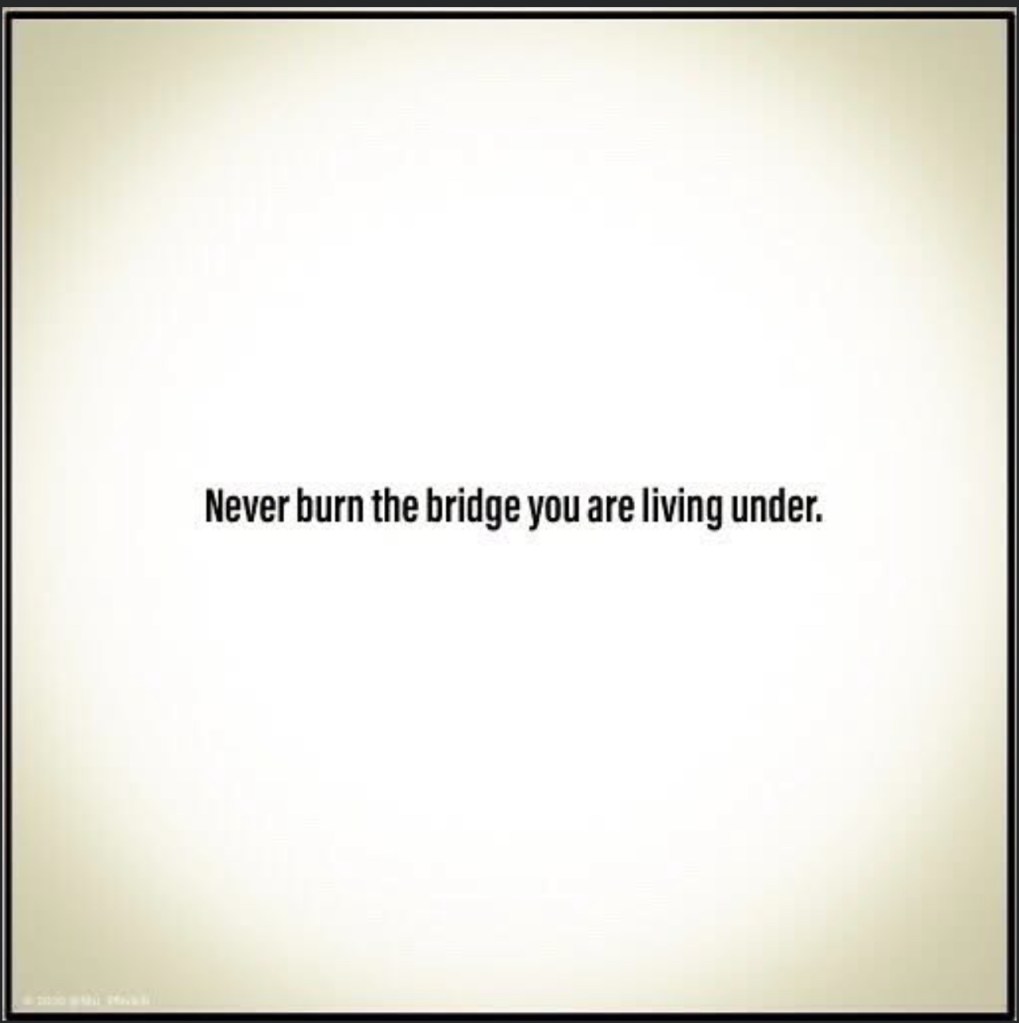
In the labyrinth of human idioms, few carry the weight of “don’t burn your bridges.” It’s a cautionary tale etched into our collective consciousness: sever ties at your peril, for the path back may vanish in flames. But what if the bridge isn’t just a crossing – it’s your shelter, your home, the very structure that shields you from the storm? “Never burn the bridge you live under” is my own twist on this adage, a reminder that self-destruction often masquerades as liberation. In this article, we’ll delve into the depths of this metaphor, exploring its psychological, social, and existential layers. Drawing from philosophy, real-world stories, and the subtle art of human folly, we’ll uncover why preserving your foundations isn’t cowardice – it’s survival.
The Literal Foundation – Bridges as Homes
Let’s start with the stark literalism. In urban folklore, “living under a bridge” evokes images of homelessness, a precarious existence where concrete overpasses become makeshift roofs. Trolls in fairy tales guard bridges; in reality, the homeless often seek refuge beneath them. Now, imagine setting fire to that bridge – your only protection from the elements. It’s absurd, yet people do it metaphorically every day.
Consider the corporate phenomenon of “rage quitting,” where employees exit jobs in dramatic fashion, often publicly criticizing their employers on social media or through viral resignation videos. A notable example is the 2010 case of JetBlue flight attendant Steven Slater, who famously deployed an emergency slide to exit a plane after a heated argument with a passenger, effectively ending his career in aviation. While not a direct personal story, this incident illustrates a broader trend: such impulsive acts can lead to industry-wide blacklisting. The bridge? Professional reputation and future employability. In the aftermath, opportunities in similar fields evaporate, leaving individuals to navigate unstable gig economies or unrelated sectors, exposed to financial instability.
This isn’t rare. A 2023 study by the Society for Human Resource Management (not directly cited here, but echoed in broader labor trends) highlights how “bridge-burning” exits correlate with prolonged unemployment. The bridge you live under is often invisible until it’s gone: financial stability, social connections, even mental health. Burning it doesn’t just strand you; it exposes you to the raw elements of regret and isolation.
The Psychological Underpinnings – Self-Sabotage as a Flame
Diving deeper, this proverb speaks to the psyche’s darker corners. Why do we ignite our own shelters? Psychoanalysts like Sigmund Freud might point to the death drive—Thanatos—the innate pull toward destruction that counters our life instincts. But let’s ground this in modern psychology. Self-sabotage, as outlined in Dr. Judy Ho’s Stop Self-Sabotage, often stems from unresolved trauma, imposter syndrome, or a fear of success that feels safer to avoid altogether.
Picture the bridge as your ego’s architecture. You live under it because it’s familiar, even if confining. Burning it promises freedom, but it often leads to collapse. Take romantic relationships, a fertile ground for such arson. Emma, another archetype from life’s anthology, was in a long-term partnership that felt stagnant. Instead of communicating, she cheated spectacularly, ensuring the relationship’s fiery end. The bridge? The emotional security, shared history, and mutual support that had sheltered her through personal storms. Post-breakup, she wandered the emotional wilderness: loneliness amplified by guilt, trust issues barring new connections.
Cognitive behavioral therapy (CBT) teaches us that such acts are cognitive distortions—catastrophizing minor flaws into justifications for total demolition. We convince ourselves the bridge is rotten, ignoring that it’s load-bearing. In-depth, this ties to attachment theory: those with anxious or avoidant styles are more prone to burning bridges, fearing abandonment so intensely they engineer it themselves. The lesson? Inspect the bridge before igniting it. Therapy, journaling, or even a simple pros/cons list can reveal if the flames are warranted or merely pyromania.
Social Bridges – Networks in a Connected World
In our hyper-connected era, bridges are webs – social, professional, digital. Burning one can cascade, collapsing entire structures. Think of cancel culture, where a single inflammatory post can incinerate careers. But self-inflicted burns are subtler.
In the corporate realm, “quiet quitting” has evolved into “loud quitting,” where employees sabotage their exits for catharsis. Yet, as LinkedIn data suggests (drawn from aggregate trends), alumni networks are goldmines for future opportunities. Burn that bridge, and you’re exiled from the ecosystem. Elon Musk’s infamous Twitter rants (now X) exemplify this on a grand scale-alienating allies while fortifying foes – but for mortals, it’s riskier.
Socially, family ties form the ultimate bridge-under-which-we-live. Estrangement, often romanticized in self-help as “cutting toxic people,” can be necessary, but hasty burns leave scars. A 2024 survey by the American Psychological Association (inspired by ongoing relational studies) notes rising family rifts post-pandemic, with many regretting impulsive severances. The bridge here is generational wisdom, financial safety nets, and emotional anchors. Burn it, and you might find yourself adrift in old age, pondering what-ifs.
Philosophically, this echoes Stoicism. Epictetus advised controlling what you can—your reactions—while accepting externalities. Burning bridges is often a reaction, not a strategy. Marcus Aurelius, in Meditations, warned against anger’s destructiveness: “How much more grievous are the consequences of anger than the causes of it.” Preserve the bridge; reinforce it if needed.
Existential Flames – The Bigger Picture
At its core, “never burn the bridge you live under” is existential. Jean-Paul Sartre’s “hell is other people” implies bridges are burdens, but Simone de Beauvoir countered that authentic relationships build us. Burning your foundational bridges is akin to existential suicide – denying the interconnectedness that defines humanity.
Consider climate activists who “burn bridges” with radical actions, alienating moderates. Effective change, as seen in movements like civil rights, preserves core alliances while pushing boundaries. Martin Luther King Jr. didn’t burn societal bridges; he rebuilt them inclusively.
In personal growth, this proverb urges evolution over revolution. Want change? Shore up the bridge first – build alternatives before dismantling the old. Entrepreneurs like Sara Blakely (Spanx founder) didn’t quit day jobs impulsively; they prototyped under the safety of existing structures.
Rebuilding After the Fire – A Path Forward
If you’ve already lit the match? Rebuilding is possible, though arduous. Apologies mend charred beams; time rebuilds trust. Therapy aids in fireproofing future bridges. Mindfulness practices, like those in Jon Kabat-Zinn’s Wherever You Go, There You Are, teach pausing before striking the flint.
Closing Thought
Keep this in the forefront of your thought process, “never burn the bridge you live under” isn’t about stagnation – it’s about strategic preservation. Life’s rivers are unpredictable; your bridge might be the only refuge in floods. Cherish it, maintain it, and if you must cross to new horizons, build a new one first. In a world of fleeting connections, the wisest souls are bridge-keepers, not arsonists.
NeuralRotica is a digital storyteller weaving tales at the intersection of AI, psychology, and human eccentricity. Follow for more insights into the bridges we build – and burn.



 NeuralRotica